Industrial age · science
First aeroplane flight
Two bicycle makers from Ohio flew a machine they had built for under a thousand dollars, and their hometown paper decided it was not news.
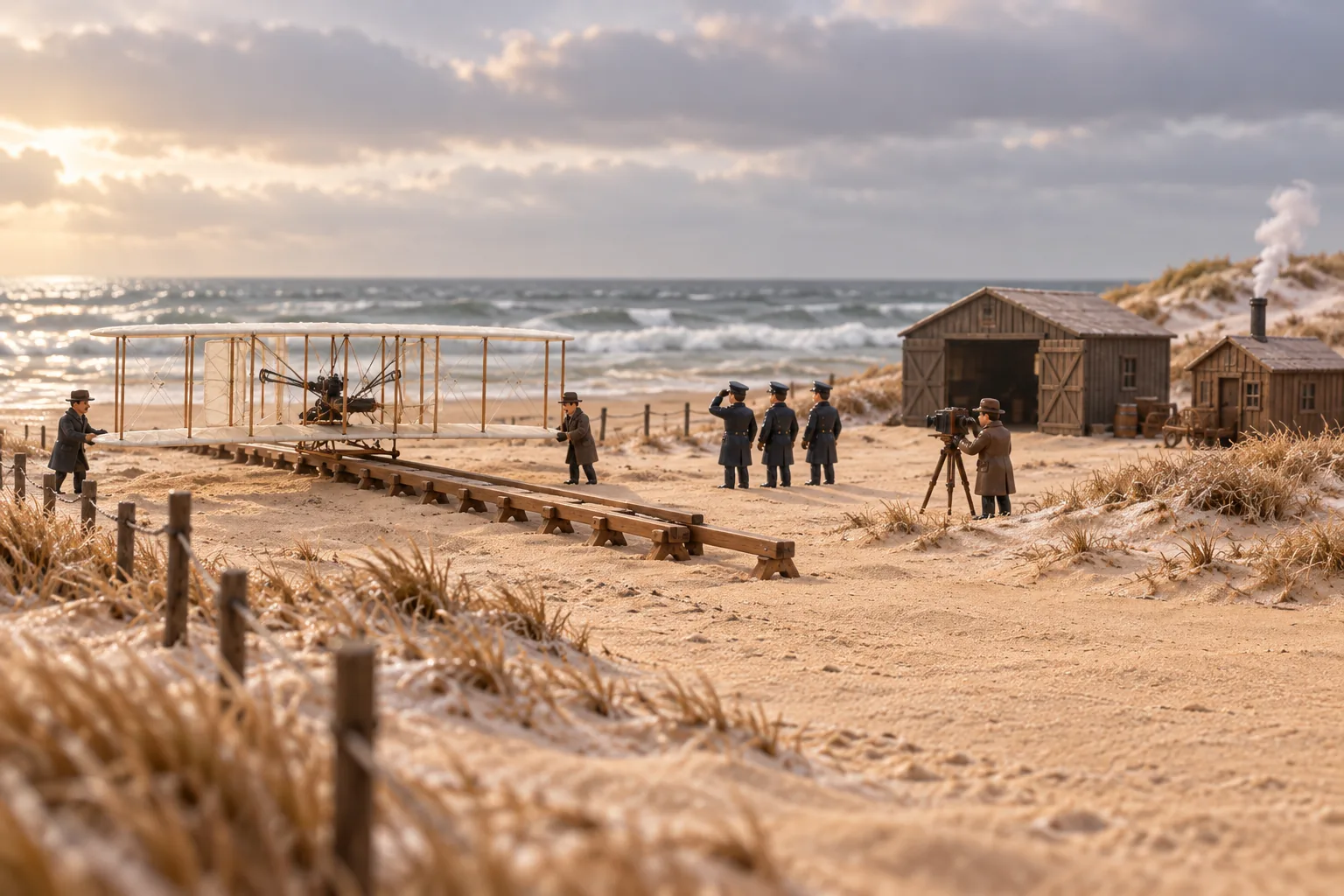
Wilbur and Orville Wright ran a bicycle shop in Dayton, Ohio. Riding bikes had taught them that an unstable machine can be balanced by a skilled rider, and they believed a flying machine was the same. While other inventors chased powerful engines, the brothers worked on control. From 1900 they tested gliders on the windy dunes near Kitty Hawk, North Carolina, and built a small wind tunnel to measure wings more accurately than anyone before them. Their mechanic Charlie Taylor built them an engine in six weeks.
On 14 December 1903 Wilbur won a coin toss and tried first, but the Flyer stalled after three seconds. Three days later, into a freezing wind gusting to 27 miles per hour, Orville took off at 10:35 am. He flew 120 feet in 12 seconds, about ten feet off the ground. The brothers took turns, and by noon Wilbur had flown 852 feet in 59 seconds. Then a gust of wind flipped the parked Flyer over several times. It never flew again.
Few believed them at first. The brothers refused to show their machine without a signed contract, and many journalists and engineers dismissed the reports. In August 1908 Wilbur flew in public at a racetrack near Le Mans in France. French newspapers had called him a 'bluffeur'; his effortless banking turns stunned the crowd, Louis Blériot among them, and the doubters apologised. Their system of steering in three directions, roll, pitch and yaw, is still how aeroplanes are flown today.
Read more on Wikipedia
