
Antiquity · person
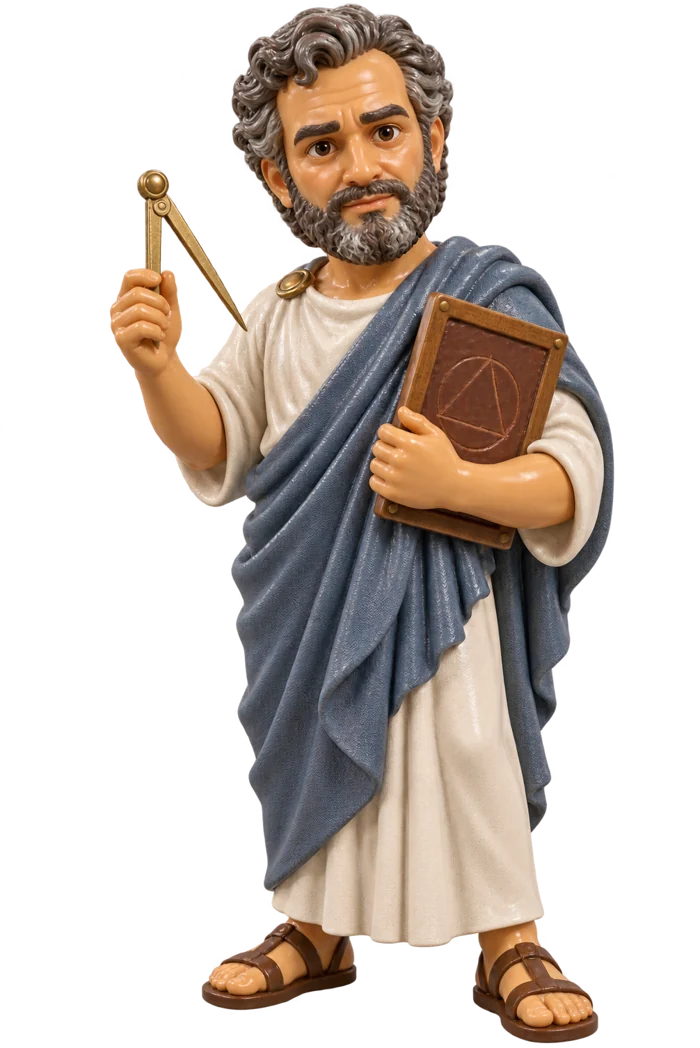
Euclid
In the new Greek city of Alexandria, a teacher started from a handful of plain statements and proved, step by step, almost everything known about lines, numbers and solids.
Almost nothing is known of Euclid's life. Most of what we have comes from Pappus of Alexandria, in the early 4th century AD, and from Proclus, in the 5th, who placed him in the reign of Ptolemy I, after Plato's followers and before Archimedes. He is presumed to have been Greek, and some scholars think he studied at Plato's Academy in Athens. He spent his career in Alexandria, the city Alexander the Great founded in 331 BC, which under Ptolemy I became a stable centre of learning.
There, around 300 BC, he wrote the Elements in thirteen books. Starting from a few definitions, postulates and common notions, it proves theorem after theorem: plane geometry in books 1 to 6, number theory in books 7 to 10 and solid geometry in books 11 to 13. It contains the Euclidean algorithm and the proof that there are infinitely many prime numbers. Much of the material came from earlier mathematicians such as Eudoxus and Theaetetus, but Euclid set it in a tight logical order. He also wrote the Optics, the Data and the Phaenomena.
The Elements became the main mathematics textbook of the medieval Arab and Latin worlds. A Latin edition was printed in 1482, and the first English one appeared in 1570. It is often called the most translated, published and studied book in Western history after the Bible, and its geometry went unchallenged until non-Euclidean geometries were discovered in the early 19th century.
Read more on Wikipedia
Sources: en.wikipedia.org/wiki/Euclid

