Industrial age · state
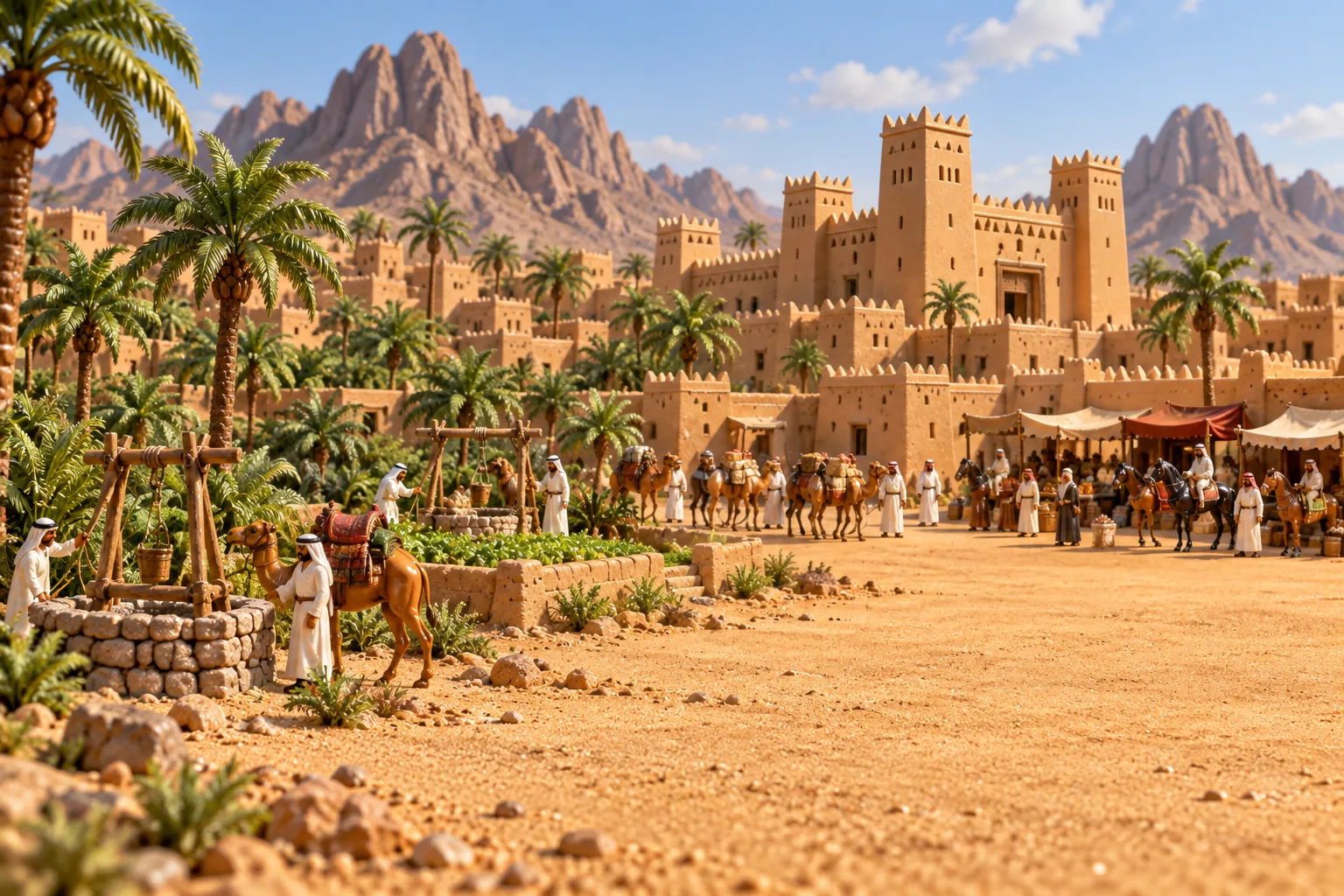
Emirate of Jabal Shammar
Its Rashidi emirs took Riyadh from the Saudis in 1891, but young Ibn Saud came back from exile and retook it in 1902.
The Shammar were a great tribal confederation of northern Arabia. In 1836 the Saudi imam Faisal bin Turki made Abdullah bin Rashid governor of Ha'il, an oasis town between the Aja and Salma mountains, and the Rashidi family went on to rule there as emirs. Abdullah brought peace to the region. His son Talal, who ruled from 1848 to 1868, completed the Barzan Palace, opened regular trade with Iraq and protected foreign merchants, even Shia traders.
The emirate lived from herding, oasis farming, crafts and trade, and Ha'il was an important stop on the road between Iraq and Iran and the holy cities. Muhammad bin Rashid, who seized power in 1869 after killing his nephew, gave it its longest and most prosperous reign. He pushed its rule to al-Jawf and Palmyra in the north and Tayma and Khaybar in the west, and after the Battle of Mulayda in 1891 he drove the Saudis from Riyadh into exile in Kuwait.
The Rashidis leaned on the Ottoman Empire, which was growing weaker. In 1902 the young Abdulaziz ibn Saud came back from Kuwait and retook Riyadh, and in 1906 the emir Abdulaziz bin Mutaib fell fighting him. Murders inside the family followed, the Ottomans lost the First World War, and on 2 November 1921 Ha'il surrendered to Ibn Saud.
Read more on Wikipedia
Sources: en.wikipedia.org/wiki/Emirate of Jabal Shammar, en.wikipedia.org/wiki/House of Rashid