
Industrial age · science
Einstein
The man who rewrote space and time did it in his spare hours, while working as a third-class patent examiner.
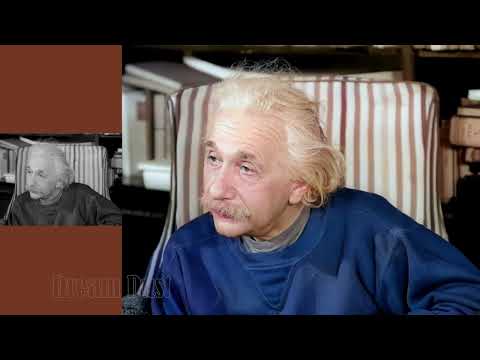
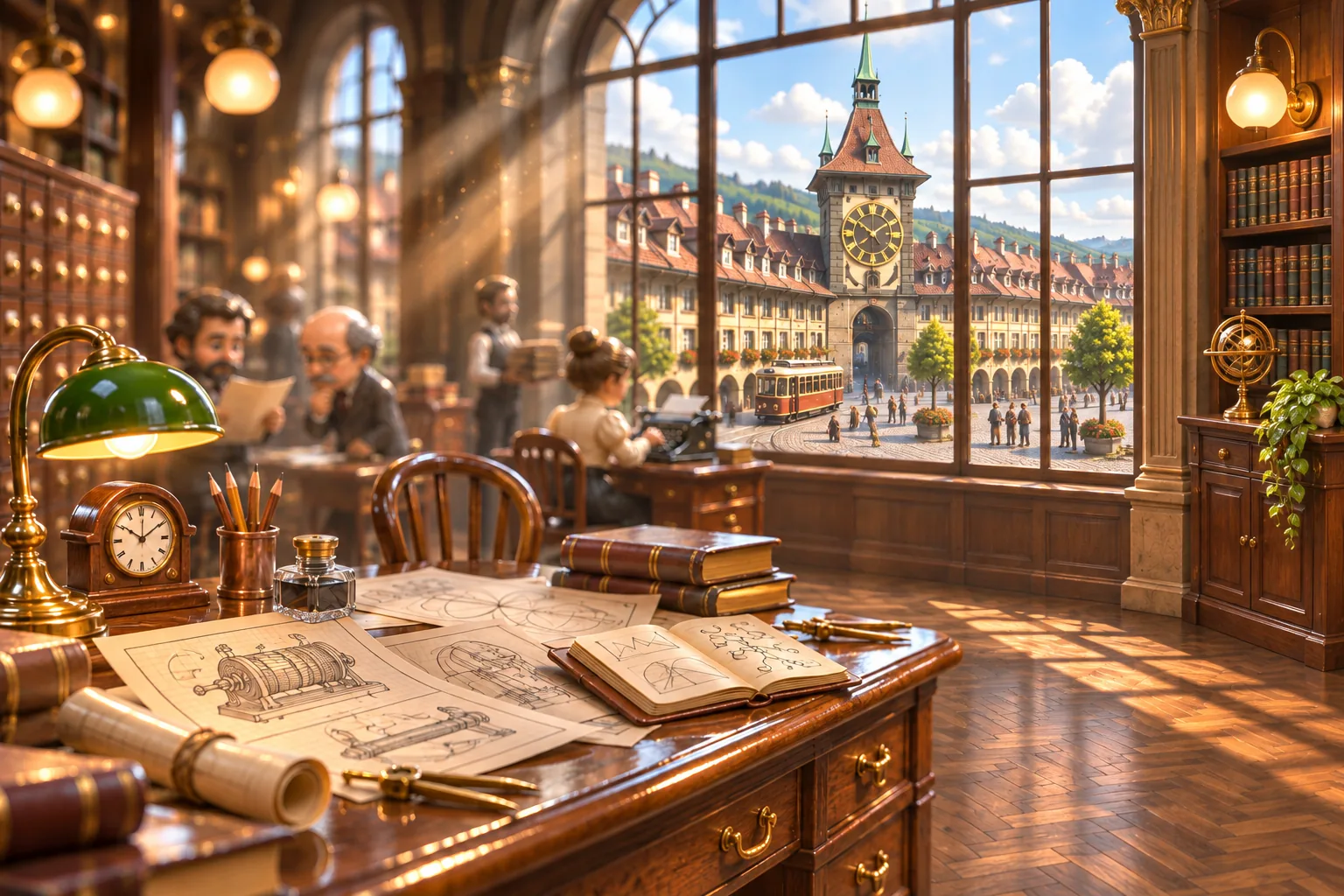
Albert Einstein was born in Ulm, in the German Empire, on 14 March 1879. He graduated from the Zurich Polytechnic in 1900 qualified to teach mathematics and physics, but could not find a university post. With help from the father of his friend Marcel Grossmann he got a job at the Swiss Patent Office in Bern as an assistant examiner, level III. He had little access to scientific libraries and few colleagues to talk to, apart from a small circle of friends who called themselves the Olympia Academy.
In 1905, aged 26, he sent four papers to the journal Annalen der Physik. The first, published on 9 June, argued that light comes in packets of energy, which became a foundation of quantum theory. The second explained the jittering of tiny particles in water, Brownian motion, and pushed physicists to accept that atoms are real. The third, received on 30 June and published on 26 September, set out special relativity: the speed of light is the same for everyone, and time and space bend to make it so. The fourth drew from it the equation E = mc², the link between mass and energy. The same year he earned his doctorate from the University of Zurich.
It took years for the world to catch up. Einstein left the patent office in 1909, published general relativity in 1915 and became the most famous scientist on Earth.
Read more on Wikipedia
Sources: en.wikipedia.org/wiki/Albert Einstein, en.wikipedia.org/wiki/Annus mirabilis papers