
Antiquity · state
Eastern Wu
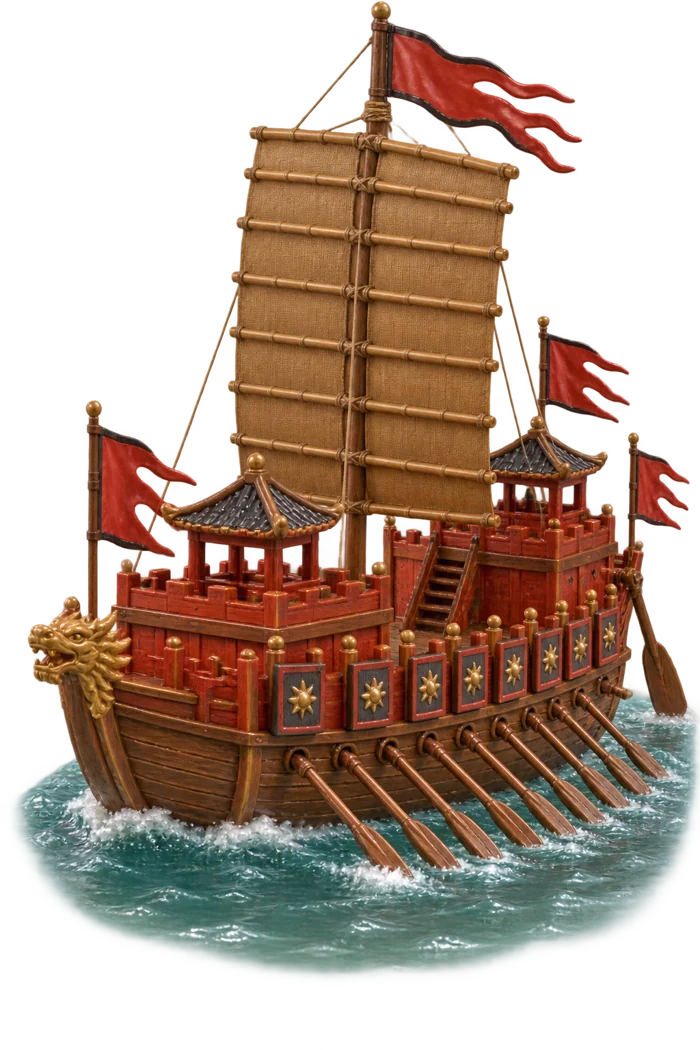
Its fire ships helped wreck Cao Cao's huge fleet at Red Cliffs in 208, and its state outlived both of its rivals among the Three Kingdoms.
As the Han dynasty collapsed, the warlord Sun Ce conquered the lands south of the lower Yangtze in the 190s. After his assassination in 200 his younger brother Sun Quan took over. In the winter of 208–209 Sun Quan and Liu Bei together defeated Cao Cao at Red Cliffs, where Wu commander Huang Gai feigned surrender and sent burning ships into Cao Cao's fleet. In 219 Sun Quan turned on his ally, and his general Lü Meng seized Jing Province and captured and executed Liu Bei's general Guan Yu.
When Cao Pi ended the Han in 220, Sun Quan accepted the title King of Wu from him, but he broke with Wei in 222 and in 229 proclaimed himself emperor. His capital was sometimes at Jianye, today's Nanjing, and sometimes at Wuchang. Under his long reign the Yangtze delta, once seen as a wild frontier, grew into a centre of Chinese commerce and culture, with new canals, shipyards, salt works and sea trade reaching Vietnam and Cambodia.
After Sun Quan died in 252, succession quarrels and corruption weakened the state. Wei conquered Shu in 263 and was itself replaced by the Jin dynasty in 266. In late 279 Jin armies attacked from six directions, and Wu's last emperor, Sun Hao, surrendered on 31 May 280, ending the Three Kingdoms period.
Read more on Wikipedia
Sources: en.wikipedia.org/wiki/Eastern Wu, en.wikipedia.org/wiki/Battle of Red Cliffs