
Our time · science
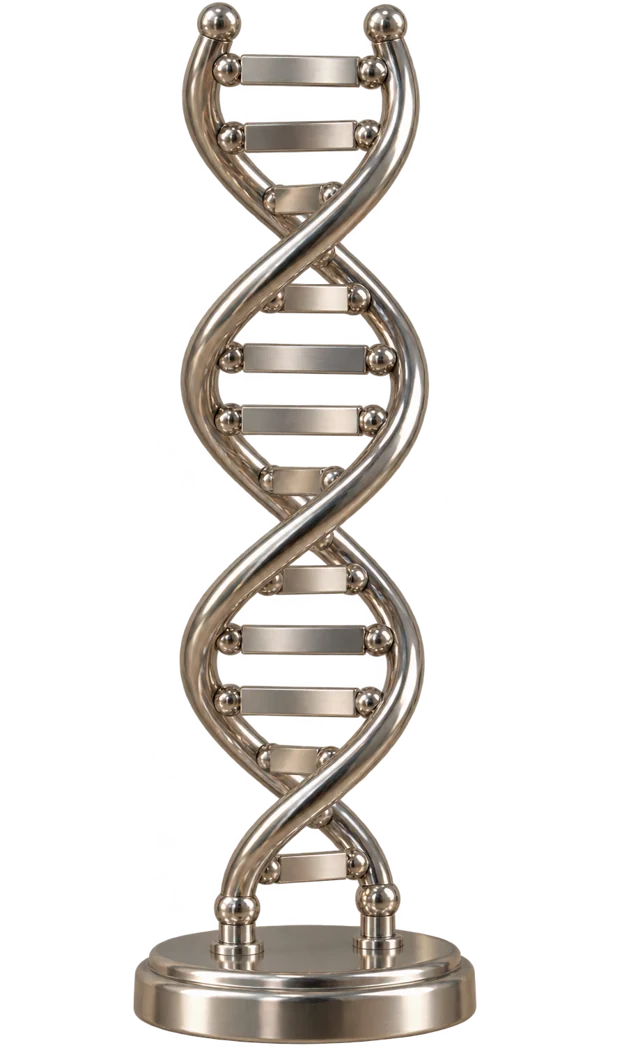
Double helix of DNA
A short letter in Nature described a twisted ladder of paired chemical letters, and with it the way living things copy their genes.
DNA had been known since 1869, and by 1952 experiments had shown that it carries genes. What nobody knew was its shape, and without the shape no one could see how it stored information or copied itself. Late in 1951 Francis Crick and James Watson began working on the problem at the Cavendish Laboratory in Cambridge, convinced they were racing the American chemist Linus Pauling.
The decisive evidence came from King's College London. In May 1952 Raymond Gosling, a PhD student working under Rosalind Franklin, took an exceptionally clear X-ray image of DNA, later called Photo 51. Maurice Wilkins showed it to Watson without Franklin's knowledge, and Crick read a research summary of hers in early 1953. The pattern pointed to a helix, and Franklin had already told them the sugar-phosphate backbones had to be on the outside. Pauling's own model, published early in 1953, had three chains and was wrong.
On 25 April 1953 Nature printed Watson and Crick's paper, followed in the same issue by papers from Wilkins's group and from Franklin and Gosling. Two strands wind around each other, held together by pairs of bases: A always with T, C always with G. The authors noted that this pairing 'immediately suggests a possible copying mechanism for the genetic material'. Watson, Crick and Wilkins shared the Nobel Prize in 1962. Franklin had died four years earlier, and the Nobel Committee never makes posthumous nominations.
Read more on Wikipedia
Sources: en.wikipedia.org/wiki/DNA, en.wikipedia.org/wiki/Molecular Structure of Nucleic Acids: A Structure for Deoxyribose Nucleic Acid, en.wikipedia.org/wiki/Photo 51