Early modern · state
Denmark–Norway
For nearly three centuries a king in Copenhagen ruled Norway, Iceland, Greenland and the Faroes, until Napoleon's defeat split them in 1814.
Denmark and Norway shared kings from 1380, when Olaf, son of Margaret I, inherited Norway, and both joined Sweden in the Kalmar Union of 1397. After Sweden left in 1523, Denmark and Norway formed a personal union in 1536–37 that grew into one state, the Twin Kingdoms. It also held Schleswig and Holstein and Norway's old islands: the Faroes, Iceland and Greenland. Its people spoke Danish, German, Norwegian, Icelandic, Faroese, Sami and Greenlandic.
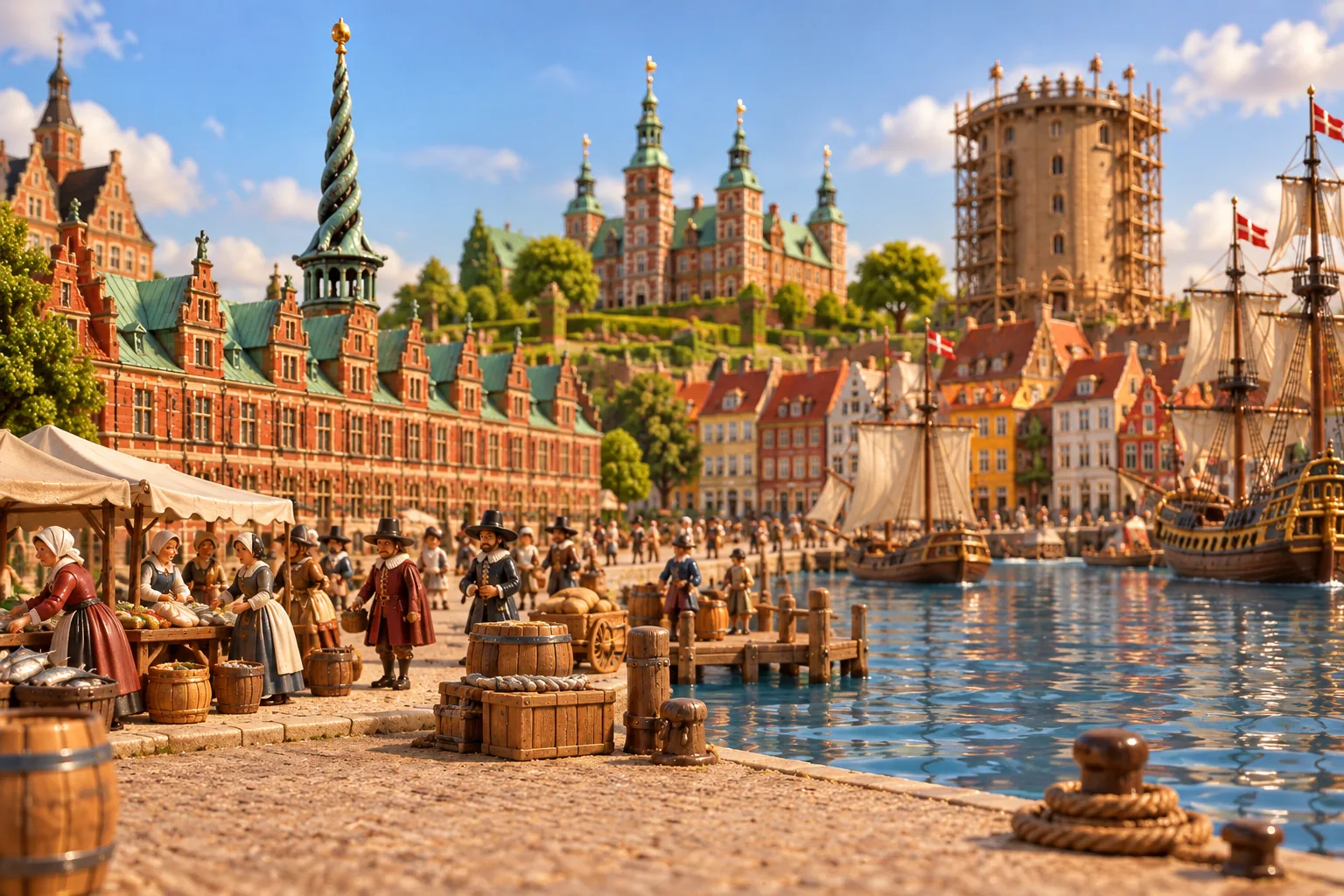
A powerful navy let the kings collect the Sound Tolls from every ship passing the Øresund, and these tolls made up two thirds of state income. Christian IV grew extremely rich. He invaded Sweden in 1611 and took Kalmar, and used the Swedish ransom to found towns named after himself, among them Christianshavn, Christianstad and Kristiansand, and to rebuild Christiania, today's Oslo. But his defeat at Lutter in 1626 in the Thirty Years' War began a long decline, and in the Treaty of Roskilde of 1658 Sweden took a quarter of the realm.
In 1660 the king became absolute, and the King's Law of 1665 made the monarchy one of the most absolute in Europe. Colonies followed at Tranquebar and Serampore in India, on the Gold Coast and in the West Indies. After Napoleon's defeat, the Treaty of Kiel of 1814 gave Norway to Sweden, while Denmark kept the islands.
Read more on Wikipedia
Sources: en.wikipedia.org/wiki/Denmark–Norway, en.wikipedia.org/wiki/Sound Dues