
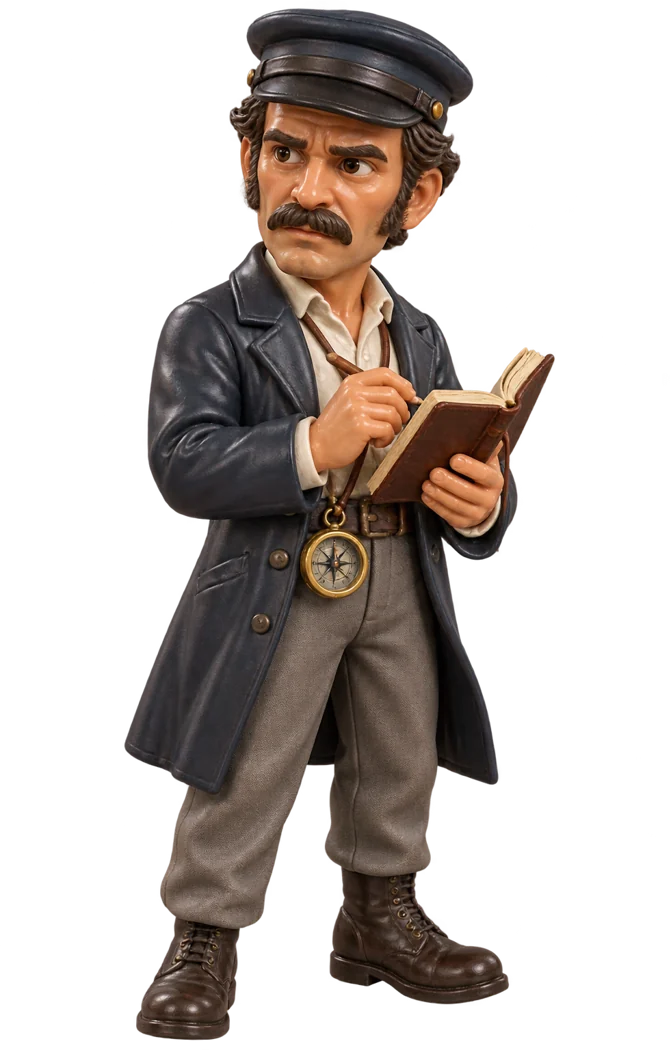
Industrial age · person
David Livingstone
Travelling down the Zambezi in 1855, he became the first European to see the falls known as Mosi-oa-Tunya, "the smoke that thunders", and named them after Queen Victoria.
David Livingstone was born on 19 March 1813 in Blantyre, Scotland, in a tenement for cotton-mill workers on the River Clyde. From the age of 10 he worked 14-hour days in the mill as a piecer, tying broken threads on the spinning machines, and later paid for his studies at Anderson's University in Glasgow by working there between terms. He qualified as a doctor in 1840 and sailed to southern Africa with the London Missionary Society.
In 1844 a lion crushed his left arm, which he could never again lift above his shoulder, and on 9 January 1845 he married Mary Moffat, a missionary's daughter. With Kololo guides he reached Luanda on the Atlantic in May 1854, then turned east with 114 Kololo men down the Zambezi, saw Mosi-oa-Tunya, named it Victoria Falls and reached Quelimane on the Indian Ocean, becoming famous as the first European to cross south-central Africa. His government-backed Zambezi expedition of 1858–1864 was called a failure, and Mary died of malaria during it in 1862. Searching for the source of the Nile, he lost contact with the outside world, until Henry Morton Stanley found him at Ujiji on 10 November 1871.
He died on 1 May 1873, aged 60, in Chief Chitambo's village near Lake Bangweulu, in today's Zambia. His attendants Chuma and Susi buried his heart under a tree there and carried his body more than 1,000 miles to the coast at Bagamoyo; he was buried in Westminster Abbey.
Read more on Wikipedia
Sources: en.wikipedia.org/wiki/David Livingstone, en.wikipedia.org/wiki/Victoria Falls
