
Industrial age · person
C. V. Raman
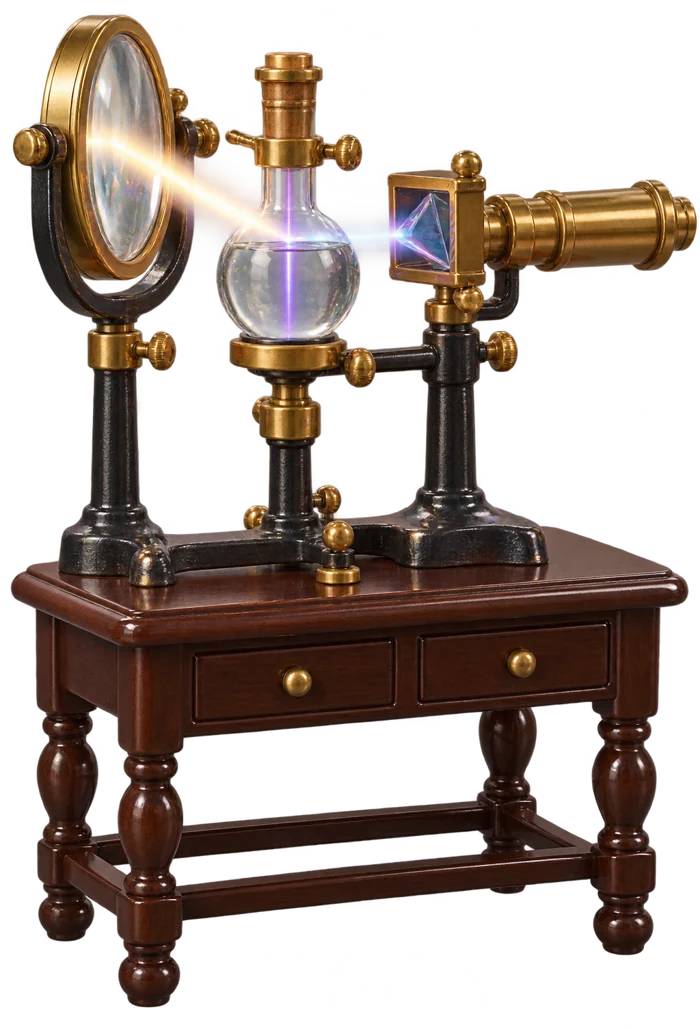
On 28 February 1928, in a Calcutta laboratory, he and his student caught light changing colour as it passed through a liquid, and two years later he became the first Asian to win the Nobel Prize in Physics.
Chandrasekhara Venkata Raman was born on 7 November 1888 in Tiruchirappalli, the second of eight children of a schoolteacher who earned ten rupees a month. He passed his matriculation at 11, and at the University of Madras he came first and won the gold medals in physics and English. His first scientific paper, on the diffraction of light, appeared in the British journal Philosophical Magazine in 1906, while he was still a student. In 1907 he came first in the Indian Finance Service exam, married Lokasundari Ammal and was posted to Calcutta as Assistant Accountant General.
In Calcutta he found the Indian Association for the Cultivation of Science, the first research institute in India, and did research there around his government job. In 1917 he became the first Palit Professor of Physics at the University of Calcutta. On his first trip to Europe in 1921, the colour of the Mediterranean convinced him that the old explanation of why the sea is blue was wrong. On 28 February 1928, with his student K. S. Krishnan, he obtained spectra showing that light scattered by a transparent substance changes its wavelength: the Raman effect. It won him the Nobel Prize in Physics in 1930.
In 1933 he moved to Bangalore as the first Indian director of the Indian Institute of Science, and in 1948 he founded the Raman Research Institute, where he worked to his last days. He died in Bangalore on 21 November 1970, aged 82, and India celebrates 28 February as National Science Day.
Read more on Wikipedia
Sources: en.wikipedia.org/wiki/C. V. Raman, en.wikipedia.org/wiki/Raman scattering
