
Ancient world · politics
Code of Hammurabi
A king of Babylon had his laws carved on a stone pillar taller than a man and promised that anyone who had been wronged could have them read aloud.
Hammurabi was the sixth king of the First Dynasty of Babylon, and he ruled from around 1792 to 1750 BC. When he came to the throne Babylon was a minor city. He waited until his powerful neighbour Rim-Sin of Larsa grew old, took his kingdom in one swift campaign, then turned on his former allies in Eshnunna, Elam and Mari. Yet his letters show a ruler who liked to call himself the shepherd of his people.
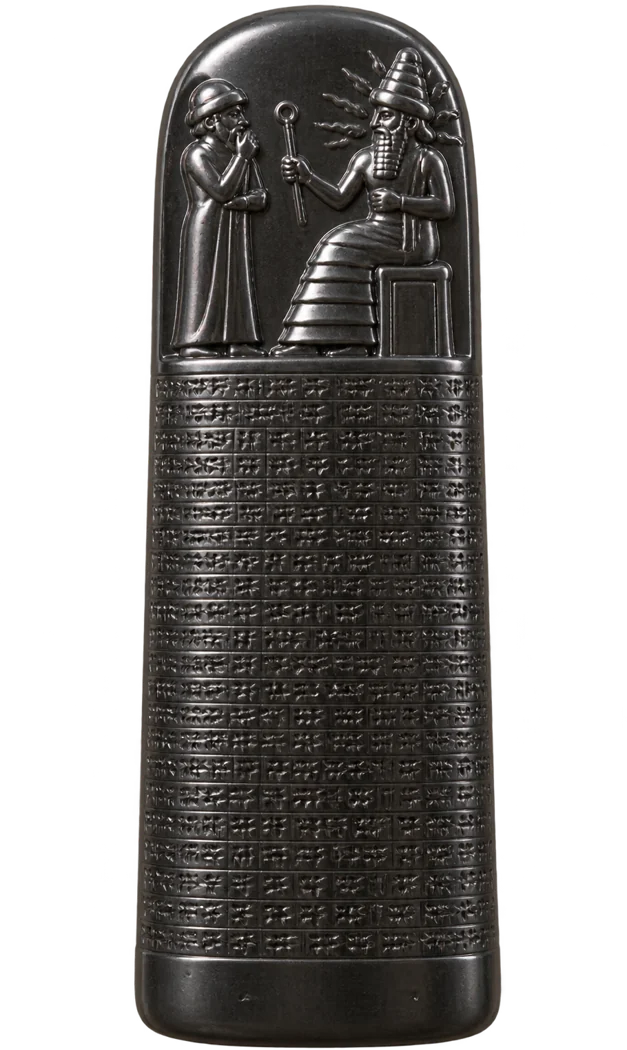
His laws were cut into a basalt stele 2.25 metres high. At the top, Hammurabi stands before the seated sun god Shamash, the god of justice. Below run about 4,130 lines of cuneiform in Akkadian. The prologue says the gods chose Hammurabi "to prevent the strong from oppressing the weak". Then come the laws, each built as "if this, then that". A surgeon who healed a gentleman with a bronze lancet earned ten shekels of silver; if the patient died, the surgeon's hand was cut off. If a house collapsed and killed the owner's son, the builder's son was put to death. People were not equal before these laws: gentlemen, commoners and slaves paid and suffered differently.
Scribes copied the text for more than a thousand years, and over 50 manuscripts survive. About 600 years after it was carved, the stele itself was carried off as plunder to Susa, in what is now Iran. French archaeologists found it there in three large pieces between December 1901 and January 1902. It now stands in the Louvre.
Read more on Wikipedia


