Antiquity · person
Cicero
As consul in 63 BC a self-made lawyer from a hill town drove the conspirator Catiline out of Rome with four speeches still read in Latin classes today.
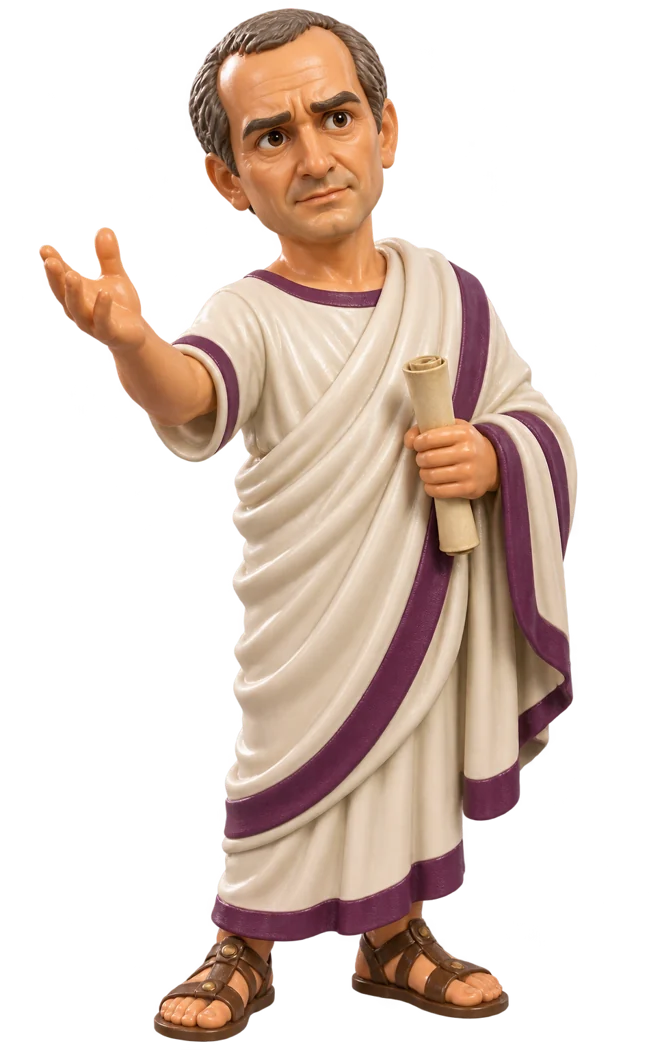
Marcus Tullius Cicero was born on 3 January 106 BC at Arpinum, a hill town about 100 kilometres southeast of Rome, into a wealthy family of the equestrian order. No one in his family had held high office, so in Rome he was a novus homo, a new man. He studied in Rome and Greece, married Terentia in 80 BC and made his name in 70 BC by prosecuting Gaius Verres, the corrupt governor of Sicily, against the famous advocate Hortensius, after gathering witnesses across the island himself.
He was elected consul for 63 BC with the support of every unit of the centuriate assembly. That year he uncovered the plot of Lucius Sergius Catilina and drove him from the city with four speeches, the Catilinarian orations, the first given in the Temple of Jupiter Stator. Letters seized from Gallic envoys exposed five conspirators, and Cicero had them strangled in the Tullianum prison without a trial. He was hailed pater patriae, father of the fatherland, but the executions led to his exile in 58 BC, and he was recalled the next year.
He sided with Pompey in the civil war and was pardoned by Caesar after Pharsalus. After Caesar's murder in 44 BC he attacked Mark Antony in a series of speeches, the Philippics. When Antony and Octavian made peace, Cicero was proscribed, and on 7 December 43 BC he was caught leaving his villa at Formiae and killed. His head and hands were shown on the Rostra in the Forum.
Read more on Wikipedia
Sources: en.wikipedia.org/wiki/Cicero