Our time · politics
Chinese economic reform
Two years after Mao died, his party quietly began to let peasants farm their own plots and foreign firms build factories, and for the next 35 years the economy grew by about 9.5 percent a year.
When Mao Zedong died in 1976, the Great Leap Forward and the Cultural Revolution had left China's economy stagnant and poor, and officials warned that food shortages could bring back the famine of 1959. On 18 December 1978, at the third plenary session of the 11th Central Committee, the Chinese Communist Party under Deng Xiaoping launched what it called reform and opening up. Deng described it as a "large scale experiment": new policies were tried locally first, and spread only once they worked.
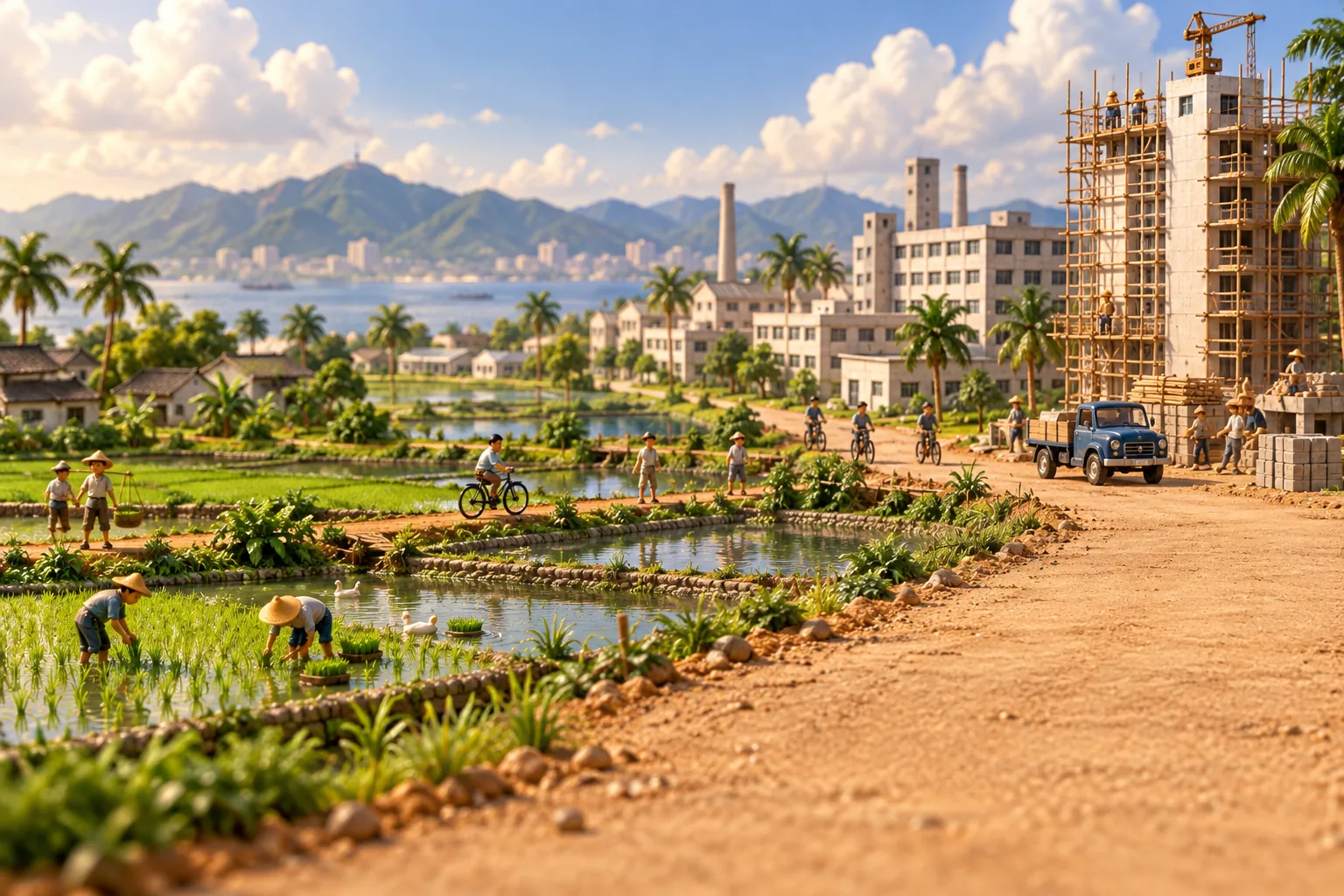
The first changes came on the farms. Under the household responsibility system, the land of the people's communes was divided into family plots, and peasants could keep what they grew beyond a contracted share sold to the state. Farm output rose by 25 percent between 1975 and 1985. Private businesses were allowed again, and factories could sell what they made above the plan. For foreign investors Deng set up Special Economic Zones in Shenzhen, Zhuhai and Xiamen. The Shekou Industrial Zone of Shenzhen, founded on 31 January 1979, was the first place in China to open up.
Political reforms of the 1980s ended with the crackdown on the Tiananmen Square protests in 1989, but Deng revived the economic reforms with his southern tour of 1992. Stock exchanges opened in Shanghai and Shenzhen in 1990, and China joined the World Trade Organization in 2001. From 1978 to 2013 the economy grew by about 9.5 percent a year, and in 2010 China overtook Japan as the world's second-largest economy.
Read more on Wikipedia