Middle Ages · state
Chalukya dynasty
A Deccan king stopped the great emperor Harsha at the Narmada, and his dynasty carved temples straight into the red cliffs of Badami.
In 543 Pulakeshin I took the hill fort of Vatapi, today's Badami in Karnataka, and made it his capital. His descendants, the Chalukyas of Badami, turned a small Deccan kingdom into one of the first great empires of the south, between the Kaveri and the Narmada. Their inscriptions are in Kannada and Sanskrit, and under them Kannada became the main language of inscriptions outside the Tamil country.
The best known of them, Pulakeshin II, halted the southward march of the northern emperor Harsha on the banks of the Narmada and conquered the eastern Deccan in 616. The Chinese pilgrim Xuanzang visited his court and praised its government, and the Persian king Khosrau II exchanged ambassadors with him. In 642 the Pallava king Narasimhavarman struck back, occupied Badami and probably killed him, and the Pallavas held the city for thirteen years.
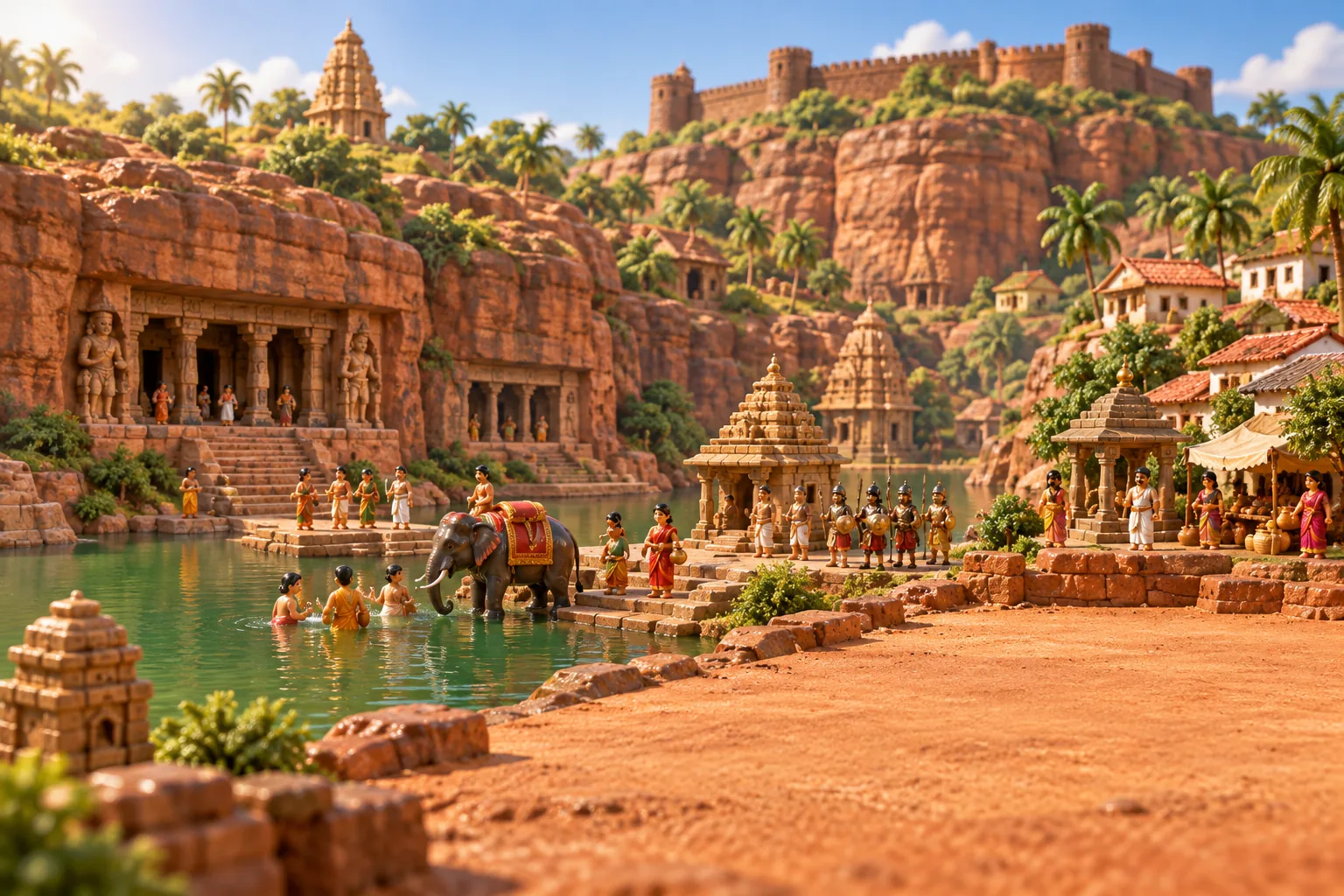
Vikramaditya I drove them out, and Vikramaditya II, from 733 to 744, invaded the Pallava lands again and again, spared the people and monuments of their capital Kanchipuram and left a Kannada inscription on a victory pillar there. The Chalukyas built cave temples at Badami and Aihole and the stone temples of Pattadakal, now a World Heritage Site. In 753 the Rashtrakuta Dantidurga overthrew the last king, Kirtivarman II.
Read more on Wikipedia