
Early modern · person
Catherine the Great
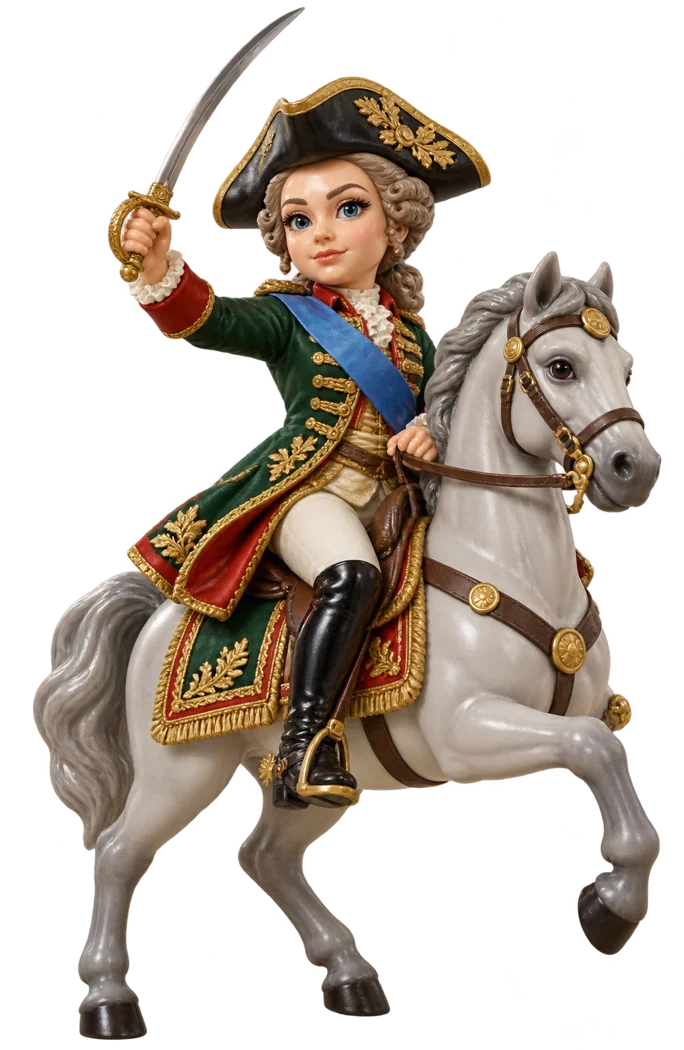
Dressed in the green uniform of the Guards, a German-born empress rode out at the head of her soldiers to take the throne from her own husband.
Catherine was born Princess Sophie Auguste Friederike von Anhalt-Zerbst on 2 May 1729 in Stettin, in the Kingdom of Prussia, today Szczecin in Poland. She was brought up on French, etiquette and Lutheran theology. Chosen as a bride for the heir to the Russian throne, she joined the Orthodox Church as Yekaterina Alekseyevna and on 21 August 1745, aged 16, married Peter, a grandson of Peter the Great. The marriage was unhappy. She read Voltaire and the French philosophes and slowly built a circle of allies, among them the Guards officer Grigory Orlov.
Peter became emperor in 1762, and his admiration for the Prussian king Frederick II alienated the very groups Catherine had cultivated. On 9 July 1762 Catherine went to the Izmailovsky Regiment and asked the soldiers to protect her from her husband. The Guards rallied to her and she was proclaimed empress in Saint Petersburg. Eight days later Peter died at Ropsha, possibly at the hands of Alexei Orlov. Her reign of over 34 years added about 520,000 square kilometres to the empire, including Crimea, Belarus and Lithuania. She founded the Smolny Institute for girls and began the Hermitage collection, but serfdom grew harsher, and the great Pugachev rebellion of 1774 was put down.
She corresponded with Voltaire for 15 years and worked with Diderot. Catherine died at the Winter Palace on 17 November 1796, aged 67, after a stroke, and was succeeded by her son Paul I.
Read more on Wikipedia