Industrial age · people
California Gold Rush
A man building a sawmill saw something shiny in the water, and within a few years 300,000 people had followed his find.
On 24 January 1848 James W. Marshall was building a sawmill for the pioneer John Sutter on the American River at Coloma, when he spotted shiny flakes of metal in the mill's tailrace. Tests showed it was gold. Sutter, who dreamed of a farming empire, wanted the news kept quiet, but his messenger let it slip three times on one trip. By March the San Francisco merchant Samuel Brannan, who had quickly opened a store for prospectors' supplies, was walking the streets holding up a vial of gold and shouting "Gold! Gold! Gold from the American River!" On 30 May the war with Mexico formally ended, and California passed to the United States.
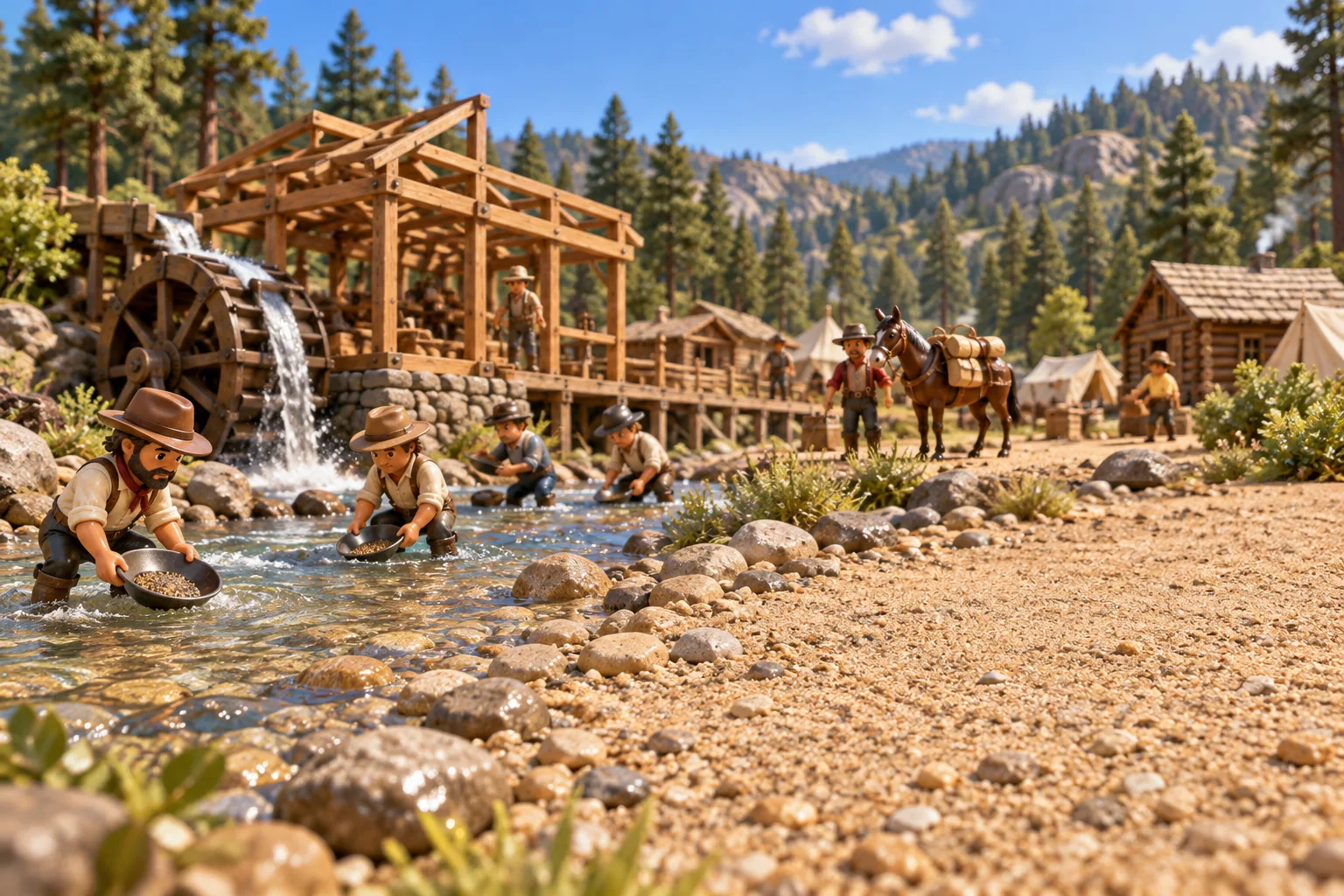
On 5 December 1848 President James K. Polk confirmed the discovery to Congress, and in 1849 the "forty-niners" poured in. Of about 300,000 newcomers, half came by sea and half overland. Most were Americans, but tens of thousands each came from Mexico, China, Britain, Australia, France and Latin America. They panned for gold in streams and later washed gravel in rockers and long toms. San Francisco grew from about 200 residents in 1846 to about 36,000 by 1852, and California became a state in September 1850.
A few grew rich, but many miners earned little more than they started with. For Native Californians the rush was a catastrophe: mining poisoned rivers and destroyed hunting grounds, and miners carried out systematic attacks on tribes near the diggings.
Read more on Wikipedia