
Our time · person
C. S. Lewis
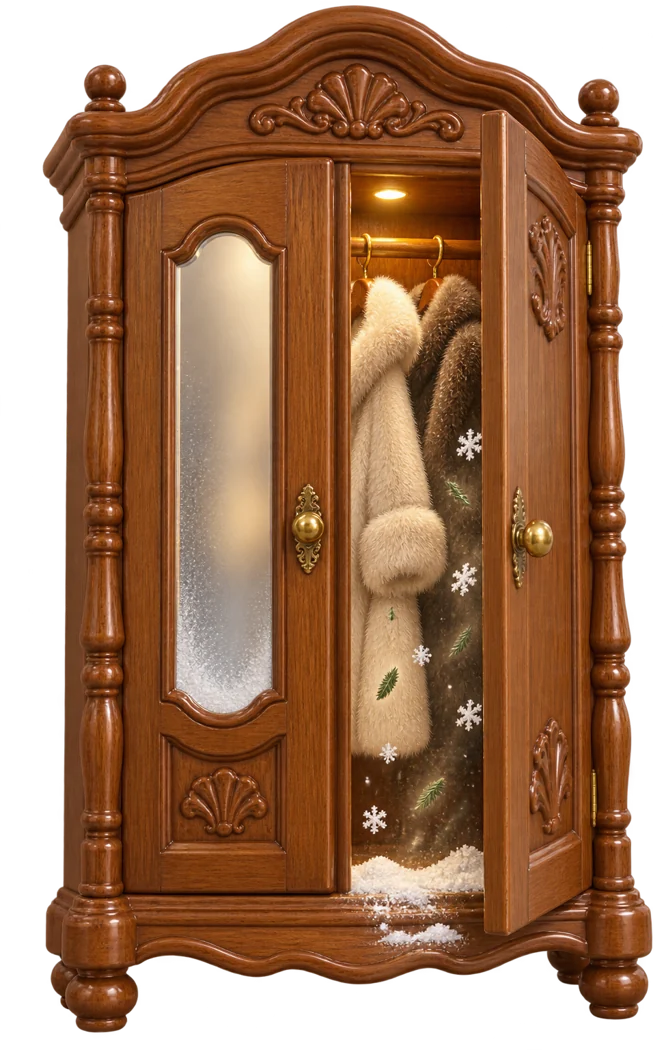
During the war, children evacuated from London came to live in an Oxford professor's house, and a few years later he wrote a story about four evacuated children who step through a wardrobe.
Clive Staples Lewis was born in Belfast on 29 November 1898, the son of a solicitor. When he was four his dog Jacksie was killed, and he took the dog's name; friends called him Jack for the rest of his life. His mother died of cancer when he was nine, and he was sent to schools in England. With his brother Warnie he invented an imaginary world of talking animals called Boxen. He lost his childhood faith and was an atheist at 15.
He went up to Oxford in 1917 and on his 19th birthday reached the front line in the Somme valley; in April 1918 he was wounded when a British shell fell short. Back at Oxford he took three firsts, and in 1925 Magdalen College made him a fellow in English, a post he held for 29 years. With J. R. R. Tolkien he was a leading light of the Inklings writers' circle. After a late-night walk along Addison's Walk with Tolkien and Hugo Dyson in 1931, he became a Christian. From 1941 to 1943 his BBC radio talks, later the book Mere Christianity, reached a wide wartime audience. Between 1949 and 1954 he wrote the seven Chronicles of Narnia, beginning with The Lion, the Witch and the Wardrobe (1950).
In 1954 he moved to a new chair at Magdalene College, Cambridge. In 1956 he married the American writer Joy Davidman, who died of cancer in 1960. He died at his Oxford home, The Kilns, on 22 November 1963, aged 64.
Read more on Wikipedia
Sources: en.wikipedia.org/wiki/C. S. Lewis


