Middle Ages · state
Breton kingdoms
Britons who crossed the sea from Devon and Cornwall gave a corner of Gaul their name, their saints and a Celtic language still spoken there.
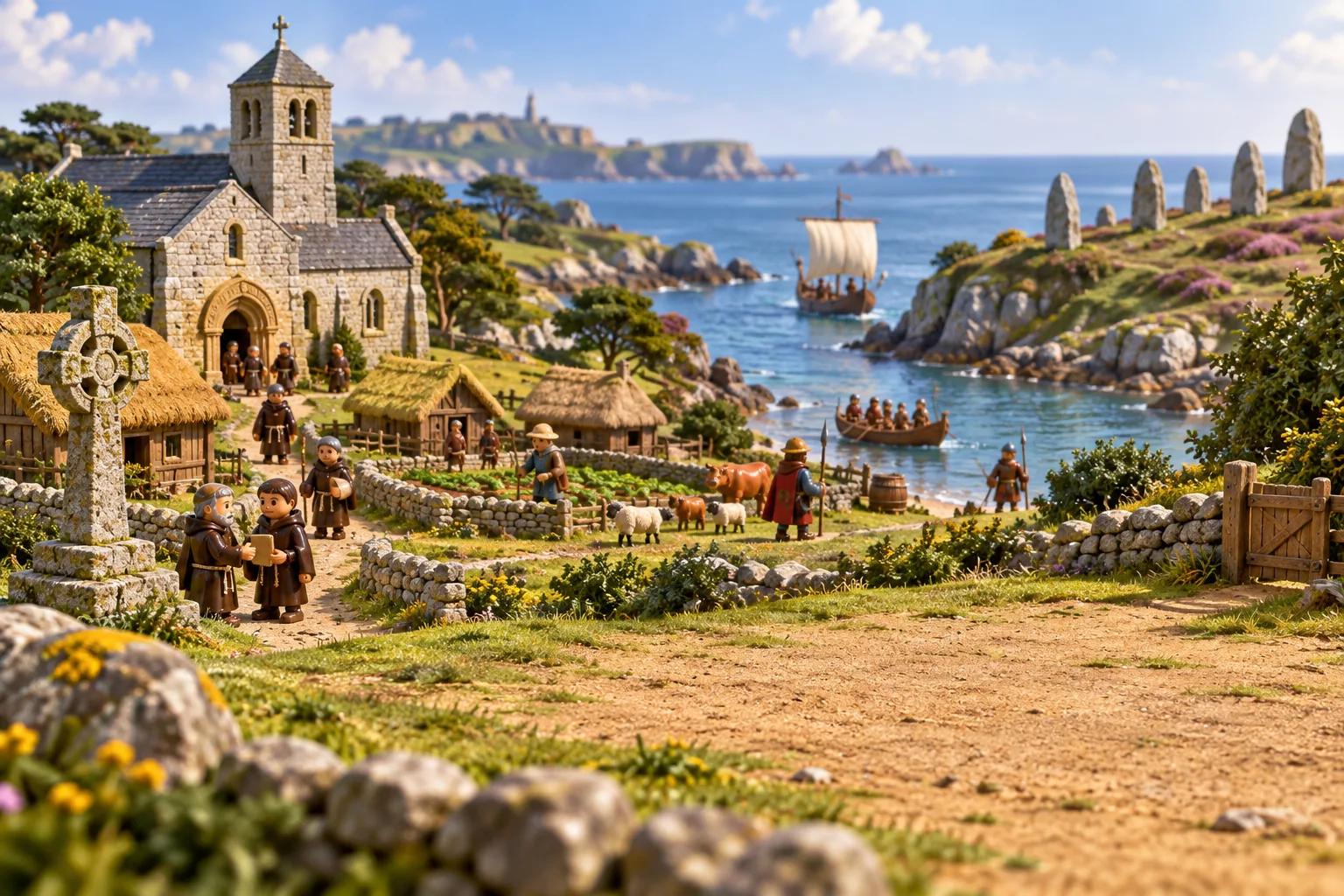
In the 5th and 6th centuries, as Anglo-Saxons and Irish raiders pressed on Britain, waves of Britons from the south-west, from Devon and Cornwall, sailed to the western end of Roman Armorica. They brought their own language, Breton, a sister of Welsh and Cornish, and Christian missionaries later remembered as the seven founder saints of Brittany. Many Breton towns are still named after such saints, and Landévennec Abbey was traditionally founded around 490 by Saint Winwaloe.
The newcomers formed small kingdoms. Domnonée in the north and Cornouaille in the south-west were named after the homelands in Britain they had left, and Bro Waroch around Vannes after its ruler Waroch. In 578 the Frankish king Chilperic I fought Waroch for three days on the Vilaine before Waroch submitted, then broke his oath, as he did again with King Guntram. To hold them back, the Franks set up a Breton March around Rennes and Nantes, whose most famous prefect was Roland, killed at Roncesvalles in 778.
After Charlemagne died in 814, the chieftain Morman was declared king, the first Breton known by that title. Louis the Pious killed him in 818, but in 845 Nominoe beat Charles the Bald at Ballon, and his son Erispoe ruled Brittany as one realm from 851.
Read more on Wikipedia
Sources: en.wikipedia.org/wiki/Bretons, en.wikipedia.org/wiki/History of Brittany, en.wikipedia.org/wiki/Waroch II, en.wikipedia.org/wiki/Morman, en.wikipedia.org/wiki/Battle of Ballon