Industrial age · war
Boxer Rebellion
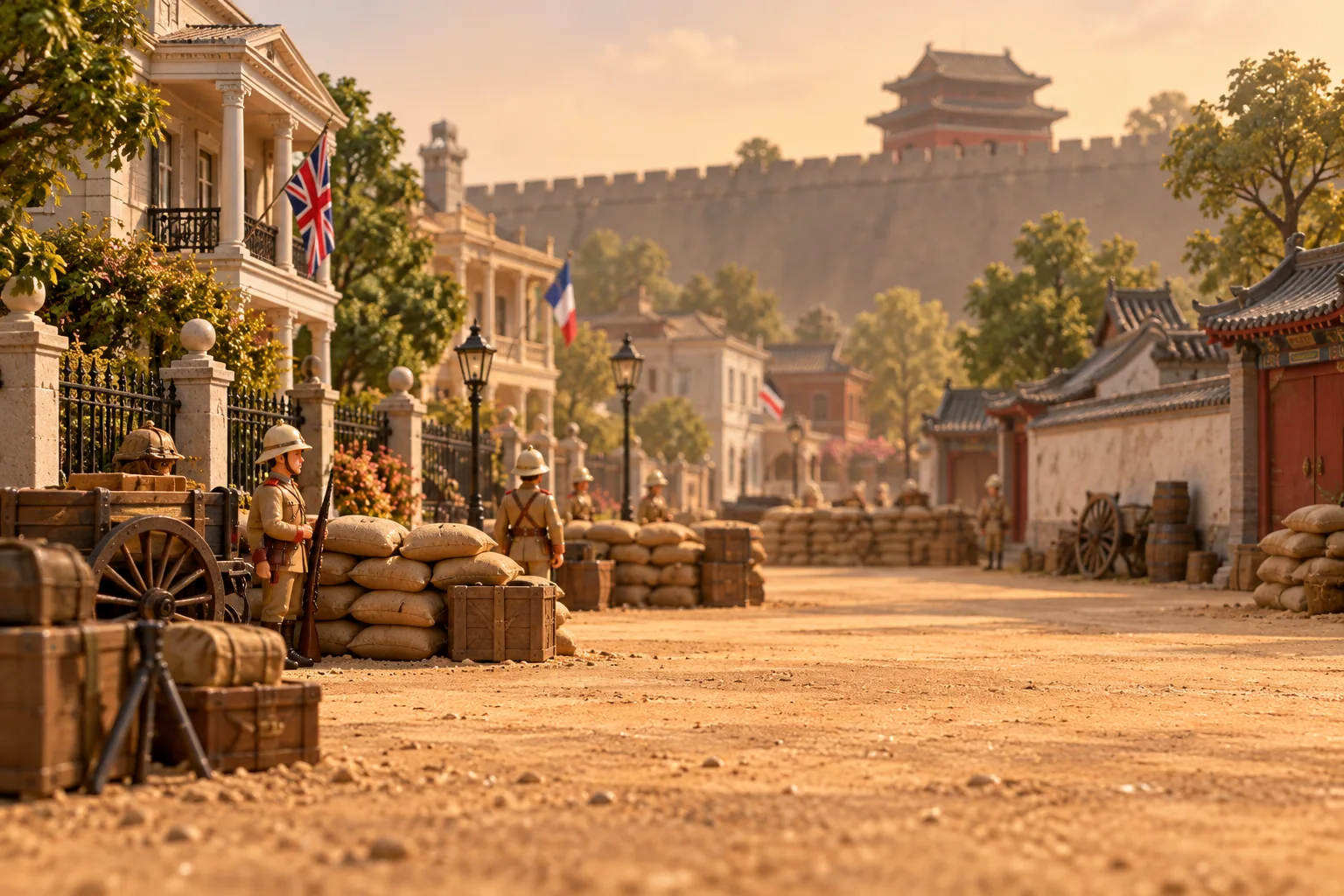
Its fighters believed spirit possession made them immune to bullets, and for 55 days in 1900 they kept the foreign diplomats of Beijing under siege.
The Society of Righteous and Harmonious Fists arose in the province of Shandong in the last years of the Qing dynasty. Its young members practised martial arts, so foreigners called them "Boxers", and many believed spirit possession made them invulnerable to bullets. After China's defeat by Japan in 1895, villagers feared the foreign powers carving out spheres of influence and resented Christian missionaries who protected their converts in court. When floods and drought struck in 1898, the Boxers blamed foreigners. From 1899 they spread across the North China Plain, tearing up railways and attacking missionaries and Chinese Christians.
In June 1900 they poured into Beijing under the slogan "Support the Qing, destroy the foreigners". The German envoy Clemens von Ketteler was killed in the street by a Manchu officer, and diplomats, soldiers, missionaries and Chinese Christians shut themselves into the Legation Quarter. Foreign troops stormed the Dagu Forts on 17 June, and on 21 June Empress Dowager Cixi issued a decree that amounted to declaring war on the powers. An Eight-Nation Alliance of American, Austro-Hungarian, British, French, German, Italian, Japanese and Russian troops fought its way to Beijing and ended the 55-day siege on 14 August. The court fled to Xi'an, and the capital was looted.
The Boxer Protocol of 7 September 1901 kept foreign troops in Beijing and made China pay 450 million taels of silver over 39 years, more than its government's yearly revenue. The humiliation weakened the Qing and helped lead to the revolution of 1911.
Read more on Wikipedia