Early modern · person
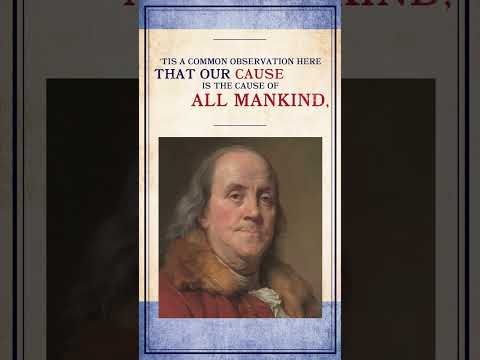
Benjamin Franklin
A printer who had run away from his brother's shop at 17 flew a kite into a thunderstorm to show that lightning is electricity, and never patented the rod that tamed it.
Benjamin Franklin was born in Boston on 17 January 1706, the fifteenth child and tenth son of Josiah Franklin. At 12 he was apprenticed to his brother James, a printer, and when James founded The New-England Courant, Benjamin slipped letters into it under the name "Silence Dogood", a middle-aged widow. At 17 he ran away to Philadelphia. He set up his own printing house in 1728, took over The Pennsylvania Gazette the next year and grew rich with Poor Richard's Almanack, written as "Richard Saunders". He founded the Library Company, a fire company and the college that became the University of Pennsylvania.
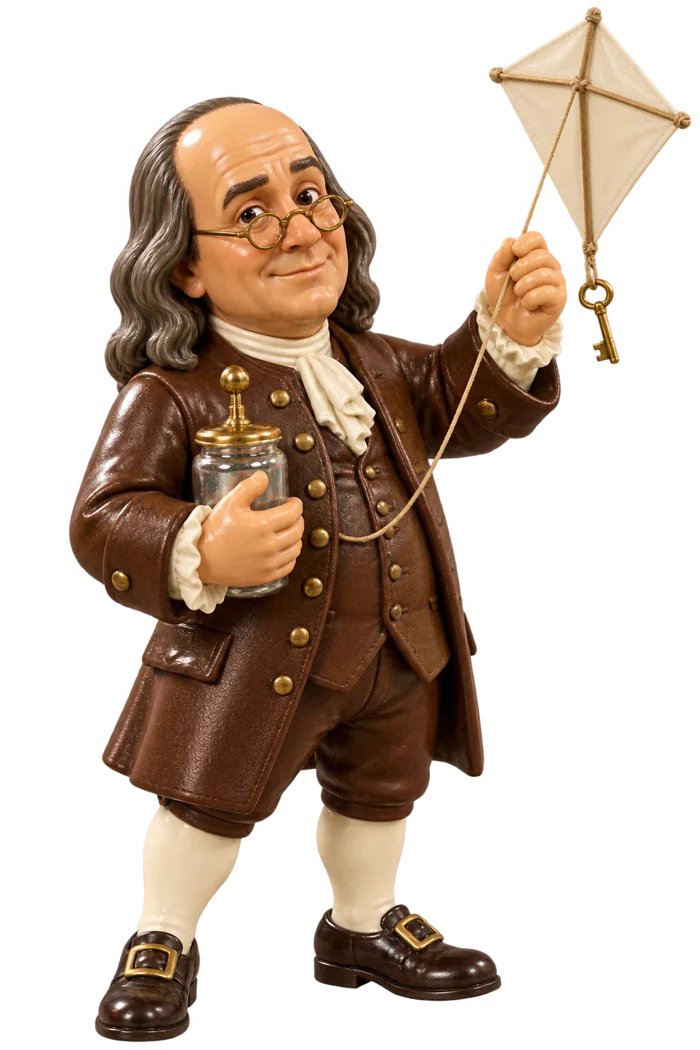
Then he turned to electricity. He named the two kinds of charge positive and negative and built a stack of glass and lead plates that he called an electrical battery. He proposed flying a kite in a storm to prove that lightning is electricity. In France, Thomas-François Dalibard drew sparks from a cloud with an iron rod on 10 May 1752, and on 15 June Franklin probably did the kite experiment in Philadelphia. His lightning rod spread around the world, and the Royal Society gave him its Copley Medal in 1753.
Franklin later charted the Gulf Stream, helped draft the Declaration of Independence in 1776 and as envoy to France secured its military alliance in 1778. He was the only person to sign the Declaration, the Treaty of Paris and the Constitution. He died in Philadelphia on 17 April 1790, and about 20,000 people attended his funeral.
Read more on Wikipedia