Antiquity · war
Battle of Thermopylae
A narrow road between a mountain and the sea, a few thousand Greeks, and the largest army they had ever seen.
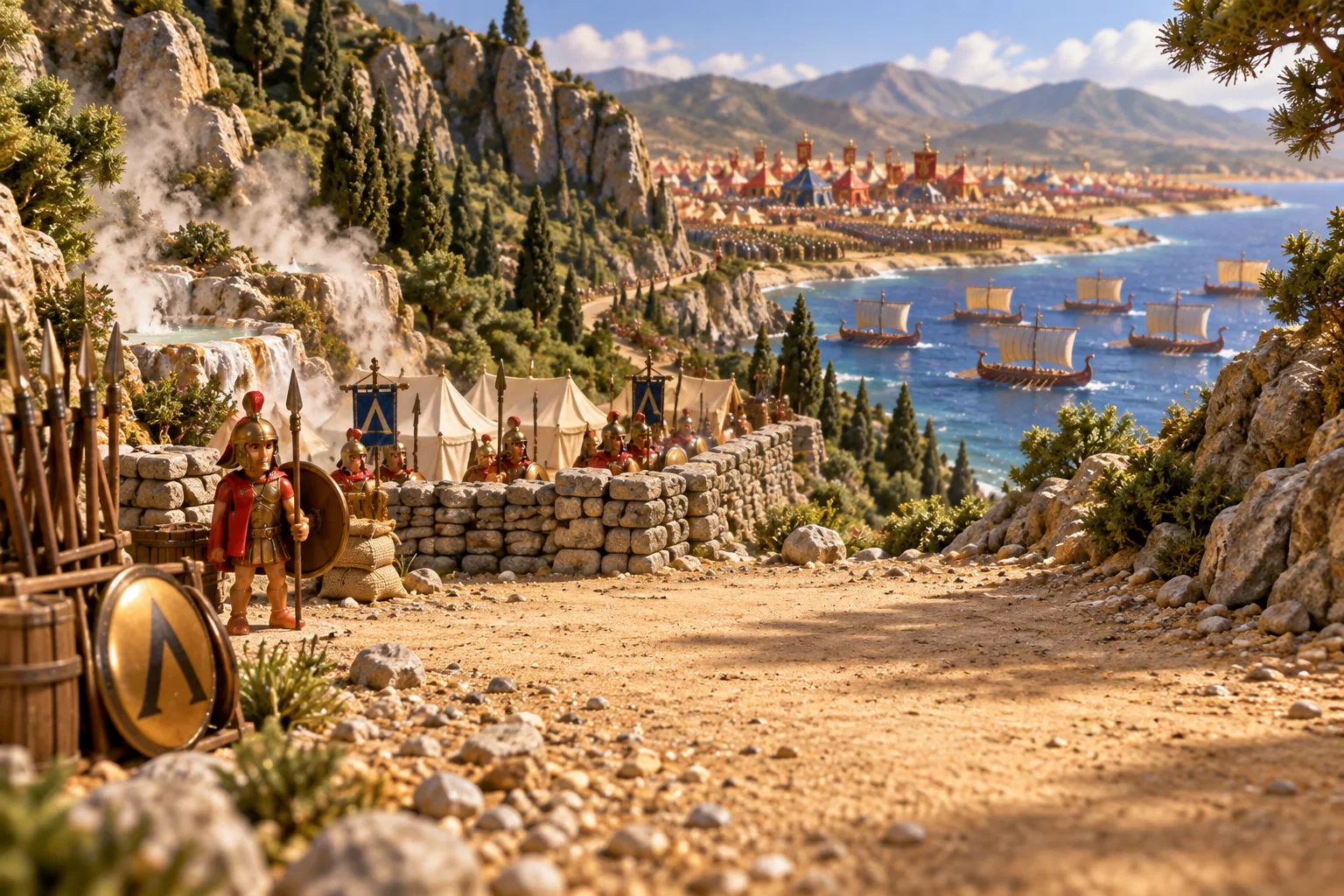
Ten years after the Persian defeat at Marathon, King Xerxes of Persia set out to conquer all of Greece with a vast army and fleet. Ancient writers claimed millions of men; modern scholars estimate between 120,000 and 300,000. The Athenian Themistocles proposed a double block: a Greek fleet at the straits of Artemisium and an army in the pass of Thermopylae, the "Hot Gates", named after its hot springs. Sparta was celebrating the Carneia festival, when war was forbidden, so King Leonidas marched north with only about 300 Spartans at the head of some 7,000 Greeks.
Leonidas held the narrowest part of the pass, the "middle gate", behind an old wall built by the Phocians. For two days wave after wave of Persians attacked and failed, even Xerxes' elite Immortals. Then a local man, Ephialtes, showed the Persians a mountain path that led behind the Greek lines. That evening Xerxes sent the Immortals along it, and at dawn the Phocians guarding the path heard them coming by the rustle of oak leaves.
Knowing he was surrounded, Leonidas sent most of the army away. He stayed with his 300 Spartans and 700 Thespians, and also with 400 Thebans, most of whom surrendered. The rest fought to the death. Greece lost the pass and Athens was captured, but later that year the Greek fleet won at Salamis, and in 479 BC the Persians were beaten on land at Plataea.
Read more on Wikipedia


