Middle Ages · war
Battle of the Yarmuk
A Byzantine emperor who had just beaten Persia sent a huge army to save Syria, and lost it in six days on a dusty plain above a gorge.
In 627 the emperor Heraclius crushed Persia and in 629 brought the True Cross back to Jerusalem. Within a few years a new power rose to the south. After the death of the Prophet Muhammad in 632 the caliph Abu Bakr united Arabia, and in 634 Arab armies invaded Byzantine Syria. They beat the Byzantines at Ajnadayn, took Damascus and by early 636 held Emesa (Homs). Heraclius, at Antioch, gathered a vast army of Armenians, Slavs, Christian Arabs and many others, and sent it south under the Armenian general Vahan.
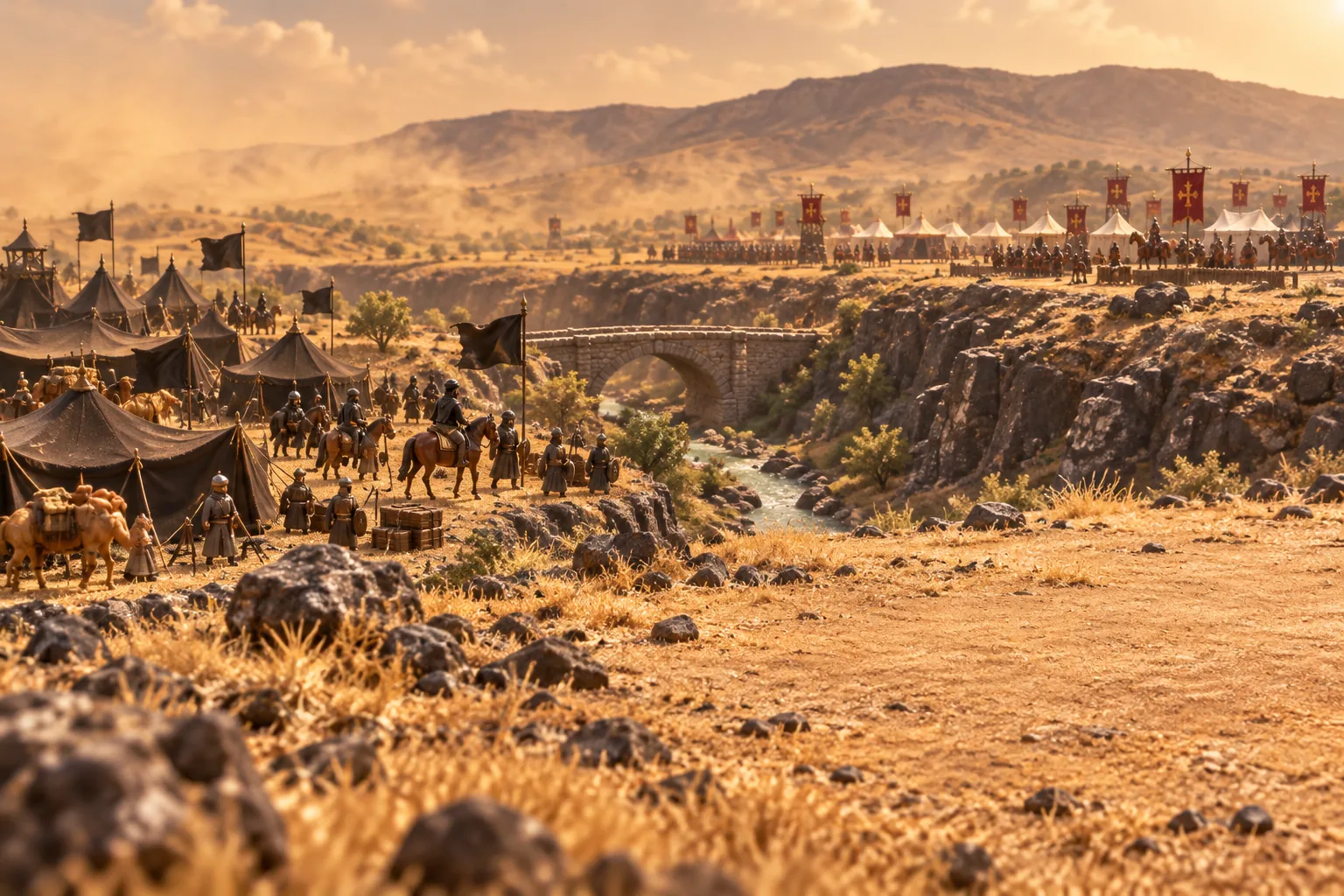
The Muslim commanders, Abu Ubayda and Khalid ibn al-Walid, pulled back from the cities and massed all their forces on the plain near the Yarmuk River, close to Arabia. Early accounts give them 36,000–40,000 men against 60,000–70,000 Byzantines. Fighting began on 15 August 636. For days the Byzantines attacked, and twice the Muslim lines were pushed back to their camps, where, the chronicles say, the women drove the men back into battle with tent poles. On the night before the last day, Khalid sent 500 riders to seize the only bridge across the deep gorge of Wadi-ur-Ruqqad.
On 20 August Khalid's massed cavalry drove the Byzantine horsemen from the field, then fell on the infantry from the flanks and rear. With the bridge blocked, the Byzantine army was trapped against the ravines and destroyed. Byzantine rule in Syria was over, and soon after the Muslims went on to conquer Egypt as well.
Read more on Wikipedia

