Our time · war
Battle of Iwo Jima
A small island of black volcanic sand cost more American casualties than its defenders lost, and gave the war its most famous photograph.
By 1944 American bombers were striking Japan from the Mariana Islands, and Iwo Jima, halfway between, was a Japanese early-warning station with airfields. In June 1944 Lieutenant General Tadamichi Kuribayashi took command there. He knew he could not win, but hoped to cause such losses that the Allies might rethink an invasion of Japan itself. Instead of defending the beaches, he had his men dig a dense network of bunkers, hidden guns and 18 kilometres of tunnels.
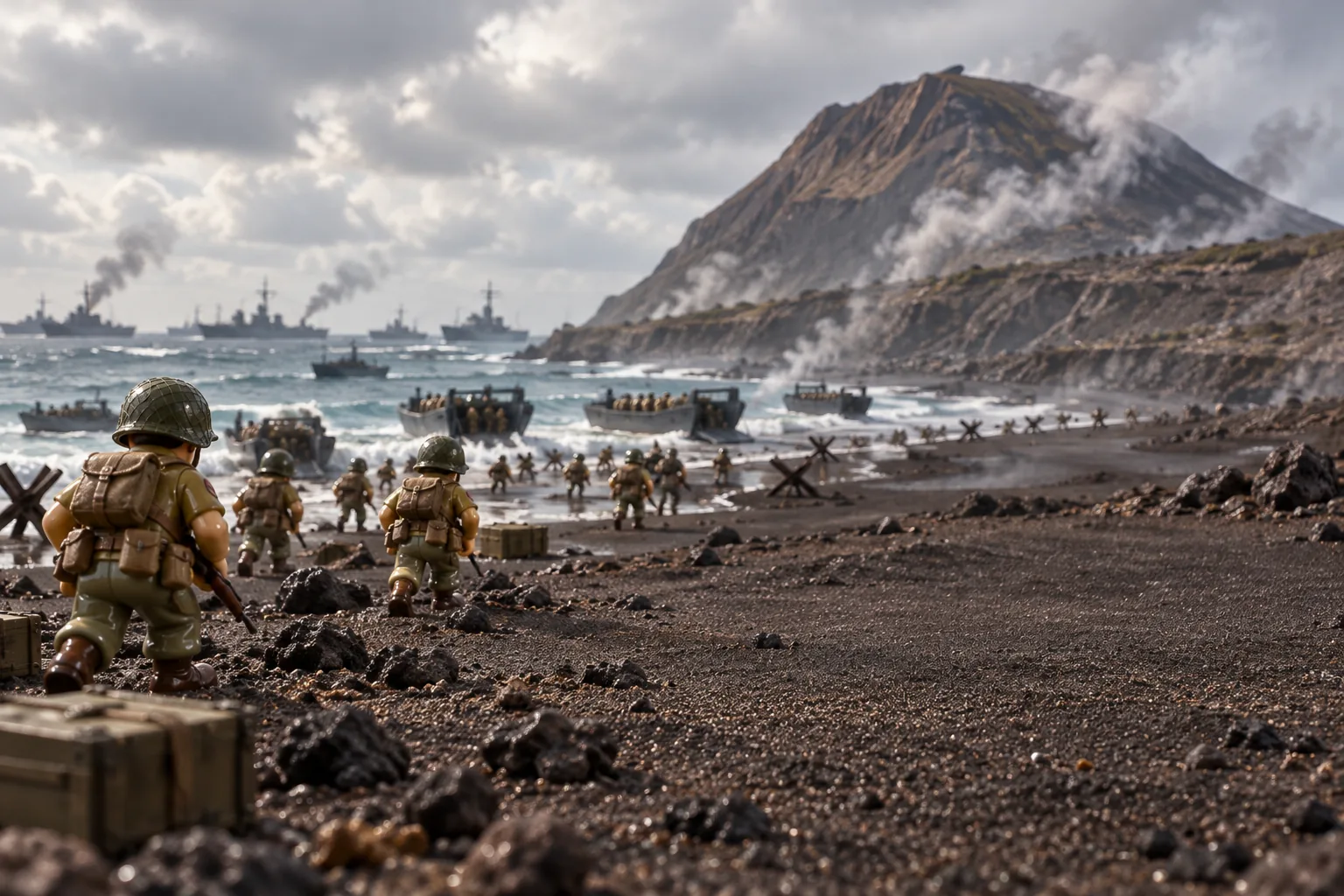
On 19 February 1945 Marines landed on the black volcanic sand after a three-day naval bombardment that did limited harm to the dug-in defenders. On 23 February a patrol reached the top of Mount Suribachi and raised a small flag on a length of Japanese water pipe. A larger flag replaced it that afternoon, and Joe Rosenthal's photograph of six Marines raising it became one of the most reproduced pictures ever taken. The fighting in the rocky north went on for weeks, one fortified ridge at a time.
The island was declared secure on 26 March. Of about 21,000 Japanese soldiers, only 216 were taken prisoner. The Americans suffered more than 26,000 casualties, including about 6,800 dead, the only Marine battle in which American casualties exceeded Japanese ones. Because all civilians had been evacuated beforehand, no civilians died on the island.
Read more on Wikipedia