Industrial age · war
Battle of Gettysburg
Three days before the biggest battle ever fought in North America, Lincoln changed the commander of his army.
In May 1863 Robert E. Lee's Confederate Army of Northern Virginia beat the Union at Chancellorsville. Lee then marched north through the Shenandoah Valley into Pennsylvania, his second invasion of the North, hoping to get as far as Harrisburg or Philadelphia and persuade northern politicians to end the war. President Abraham Lincoln replaced the commander of the Union's Army of the Potomac, Joseph Hooker, with George Meade on 28 June, just three days before the armies met.
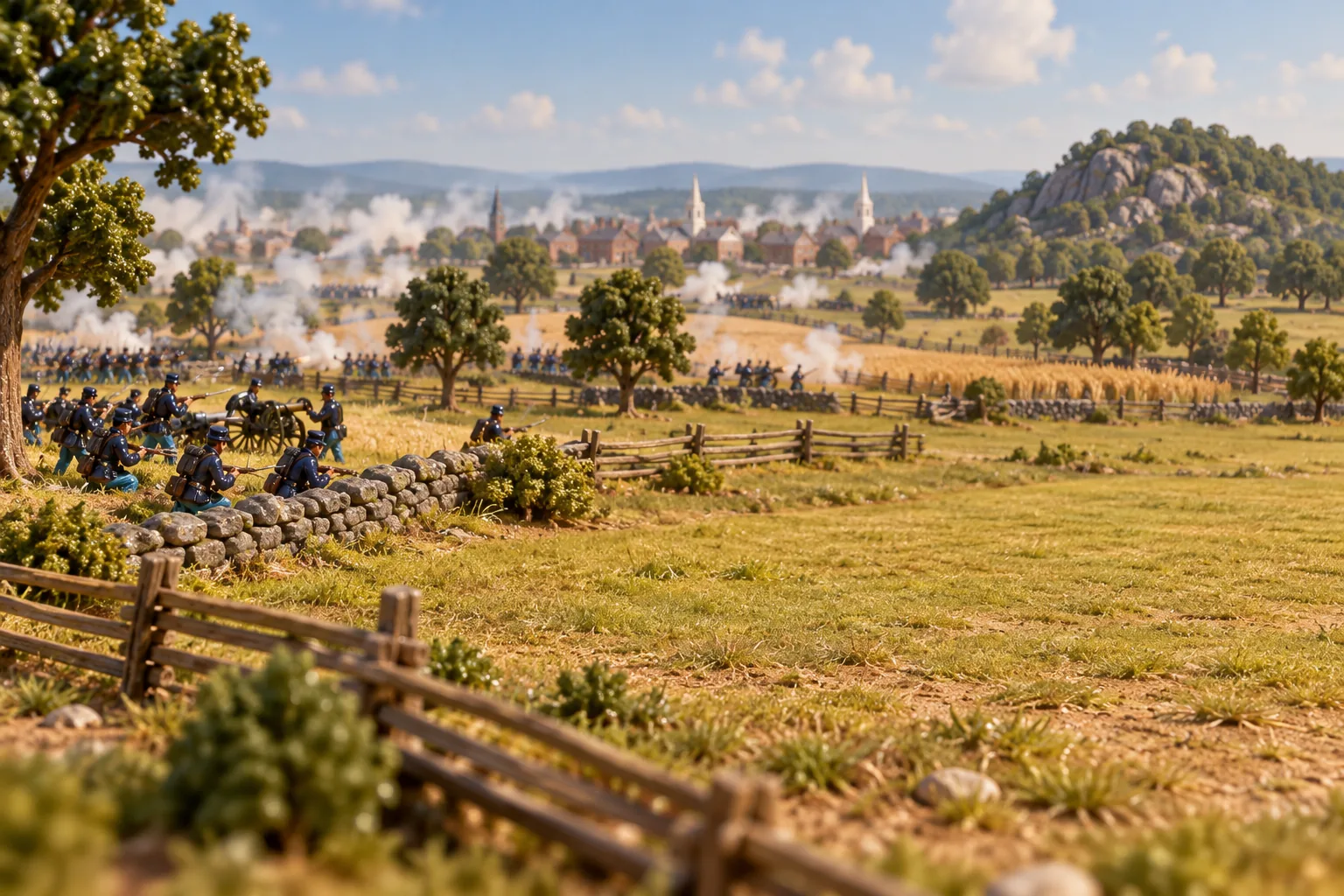
On 1 July they collided at the small town of Gettysburg. Union cavalry under John Buford held the low ridges northwest of the town until infantry arrived, but two Confederate corps broke the Union lines, and the survivors fell back through the streets to the hills south of town. On 2 July the Union army stood in a line shaped like a fishhook. Lee attacked its left at Little Round Top, the Wheatfield, Devil's Den and the Peach Orchard, and its right at Culp's Hill and Cemetery Hill. The line held.
On 3 July about 12,000 Confederate infantry marched across open fields against the centre of the Union line on Cemetery Ridge, the attack known as Pickett's Charge. Torn apart by rifle and cannon fire, they briefly reached the ridge and were thrown back. On 4 July Lee began to retreat, and the same day Vicksburg surrendered to Ulysses S. Grant. Between 46,000 and 51,000 men were casualties at Gettysburg, the most in any American battle up to then.
Read more on Wikipedia