Our time · war
Battle of Berlin
Almost a million soldiers and 20,000 tanks and guns were thrown at the last line before the German capital, and two weeks later the war in Europe was over.
By February 1945 the Red Army stood on the Oder River, 60 kilometres east of Berlin. The Western Allies chose not to race for the city, which was already promised to the Soviet zone, and General Eisenhower saw no reason to spend lives on it. On 16 April the Soviet offensive began. At the Seelow Heights, the last defensive line, nearly a million Red Army soldiers broke through about 100,000 German defenders in four days.
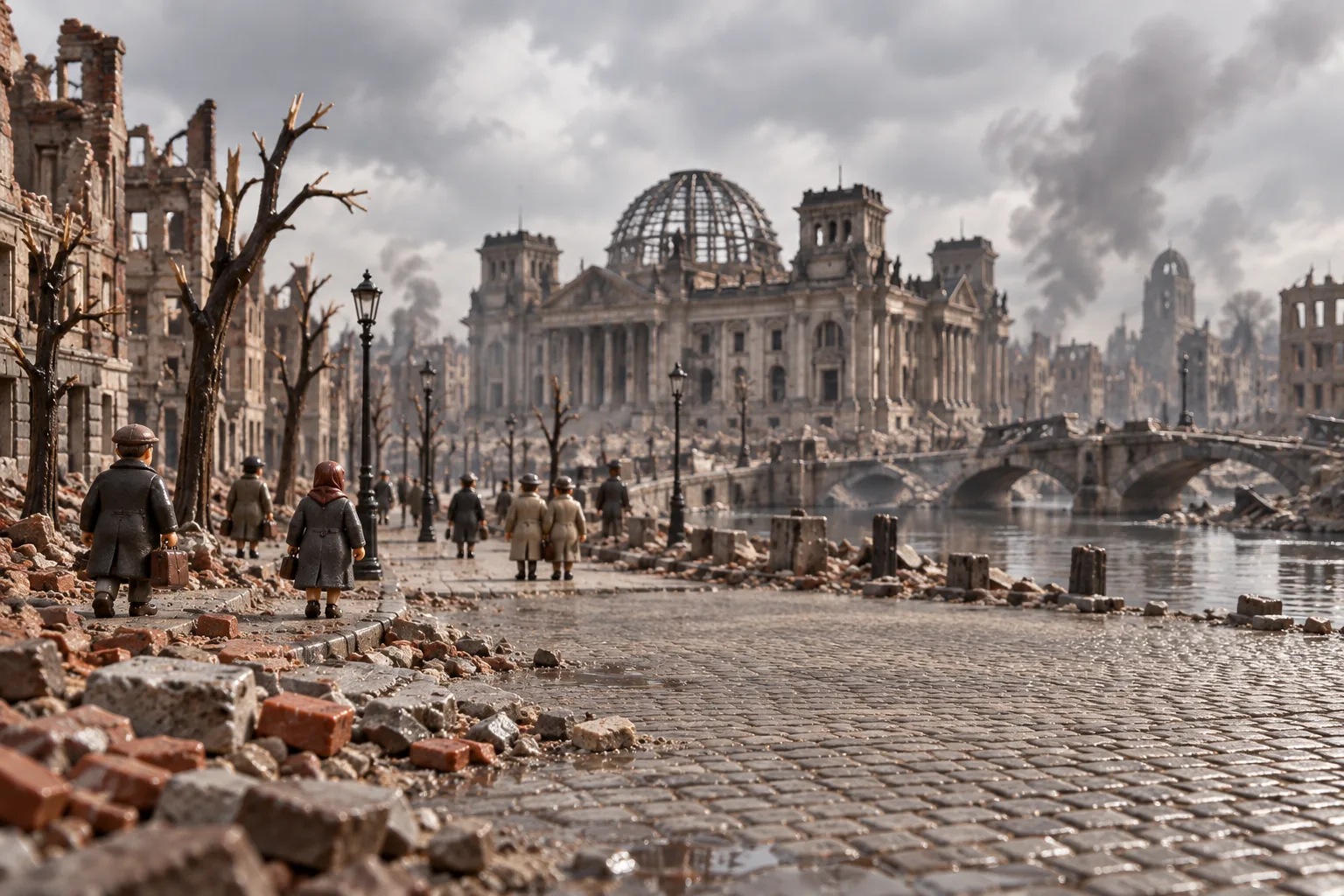
On 20 April Marshal Georgy Zhukov's guns began shelling the city centre, while Marshal Ivan Konev's armies swept in from the south, and Berlin was soon encircled. Inside, General Helmuth Weidling commanded worn-out army units, old men of the Volkssturm militia and teenage boys. Street by street the Soviets pushed toward the government quarter. On 30 April Hitler killed himself in his bunker, while Soviet troops fought room by room for the burnt-out Reichstag. Early on 2 May Weidling surrendered and ordered the garrison to lay down its arms.
The cost was enormous. Soviet archives give 81,116 Soviet dead for the operation, German dead were between 92,000 and 100,000, and some 125,000 civilians are estimated to have died. Many women suffered mass rape by Soviet troops. A month after the surrender more than a million Berliners were homeless.
Read more on Wikipedia