Ancient world · state
Babylonia
Babylon's scholars counted in sixties, which is why an hour still has 60 minutes and a circle 360 degrees.
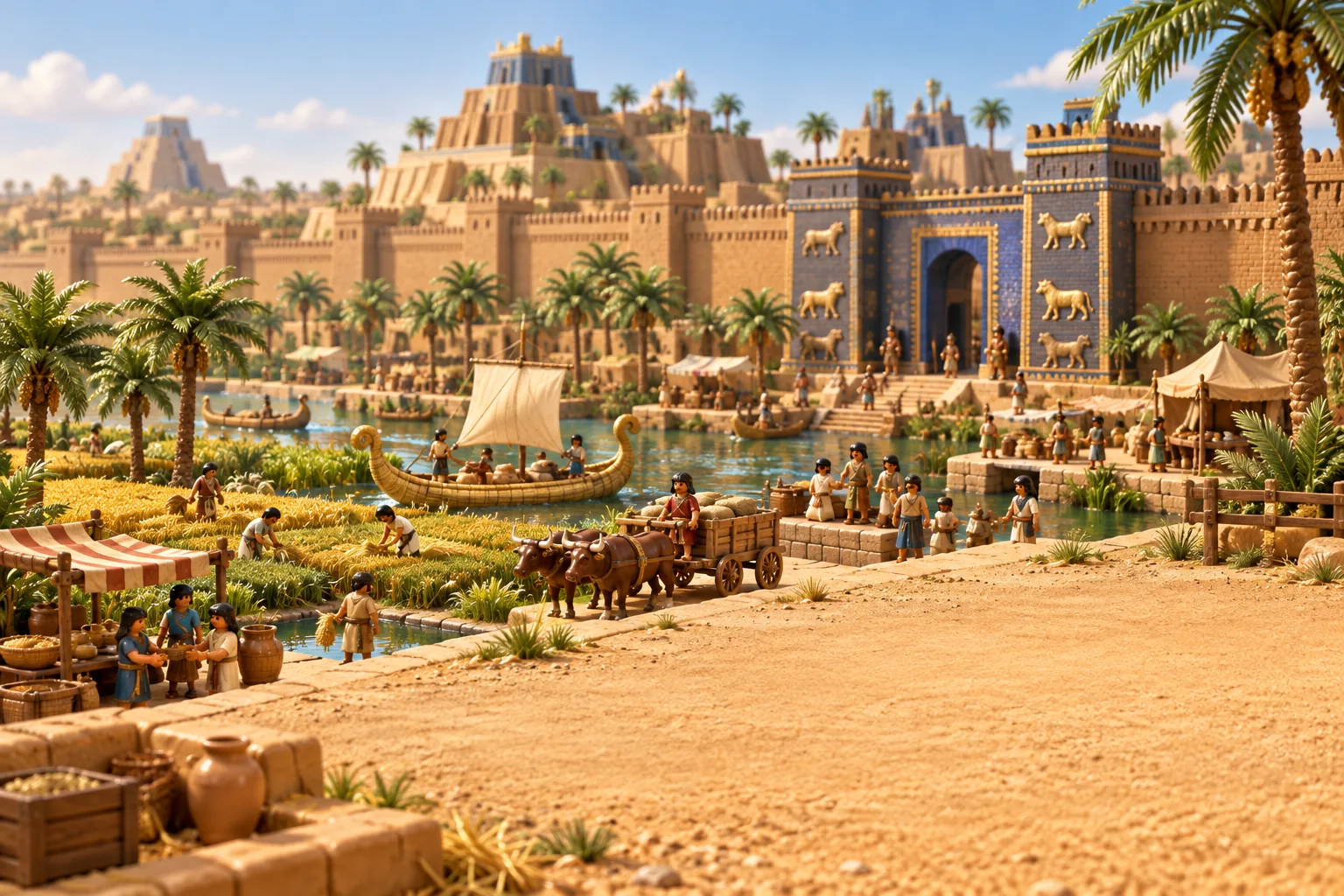
Around 1894 BC an Amorite chieftain named Sumu-abum took a tract of land that included Babylon, then a small town in central-southern Mesopotamia, and made it a state of its own. Its rulers wrote in Akkadian and kept Sumerian for sacred texts. For about a century the little kingdom was overshadowed by Isin, Larsa, Assyria and Elam.
Hammurabi, who ruled from 1792 to 1750 BC, turned Babylon into a great city, drove the Elamites out of southern Mesopotamia and conquered Isin, Larsa, Ur, Uruk and Mari, and forced Assyria to pay tribute. Only from his time was the region called Babylonia. He made Babylon's god Marduk supreme and issued his law code; a copy carved on a stele was found at Susa in 1901 and is now in the Louvre. His empire soon fell apart. The Hittites sacked Babylon around 1595 BC, and the Kassites then ruled for 576 years, the longest dynasty in its history.
From 911 BC Assyria dominated Babylonia, and Sennacherib largely destroyed the city. In 620 BC Nabopolassar seized power, joined the Medes and sacked Nineveh in 612 BC. His son Nebuchadnezzar II, who reigned from 605 to 562 BC, ruled the Levant, deported much of the population of Judah and is credited with the Hanging Gardens. In 539 BC the soldiers of Cyrus the Great entered Babylon without fighting, and Babylonia became a Persian province.
Read more on Wikipedia
Sources: en.wikipedia.org/wiki/Babylonia


