
Industrial age · person
B. R. Ambedkar
A speech written for a conference against caste was thought too radical to be given, so he published it himself, and Annihilation of Caste became one of India's most argued-over books.
Bhimrao Ramji Ambedkar was born on 14 April 1891 in the army town of Mhow, where his father served in the British Indian Army. His family were Mahars, a Dalit caste treated as untouchable. At school he could not touch the water or the cup, and if the peon was not there to pour it, he went thirsty. In Bombay he became the first of his caste at Elphinstone College, and with a scholarship from the Gaekwad of Baroda he studied at Columbia University in New York and at the London School of Economics, earning doctorates from both, while also training as a barrister at Gray's Inn.
Back in India he fought for the right to public water, leading a satyagraha at Mahad, and on 25 December 1927 burned copies of the Manusmriti, the ancient law code he blamed for untouchability. In 1936 he founded the Independent Labour Party, and on 15 May 1936 published Annihilation of Caste, a speech that Lahore reformers had invited and then cancelled as too controversial. It argued that caste would fall only when the religious notions behind it were destroyed.
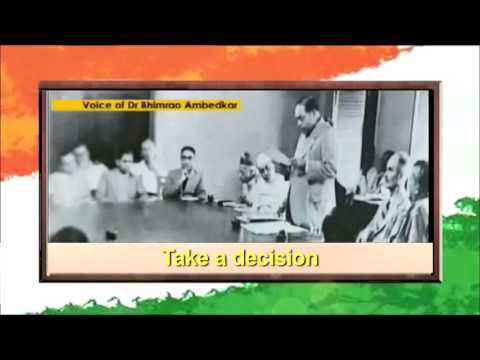
After independence in 1947 Nehru made him law minister, and he chaired the committee that drafted the Constitution of India. He resigned in 1951 when the Hindu Code Bill was blocked. On 14 October 1956 in Nagpur he became a Buddhist with some 500,000 followers. He died in his sleep in Delhi on 6 December 1956, three days after finishing The Buddha and His Dhamma; in 1990 he was awarded the Bharat Ratna.
Read more on Wikipedia
Sources: en.wikipedia.org/wiki/B. R. Ambedkar, en.wikipedia.org/wiki/Annihilation of Caste