Early modern · state
Aztec Empire
A people who settled on a swampy island in a lake built one of the largest cities in the world there in under two hundred years.
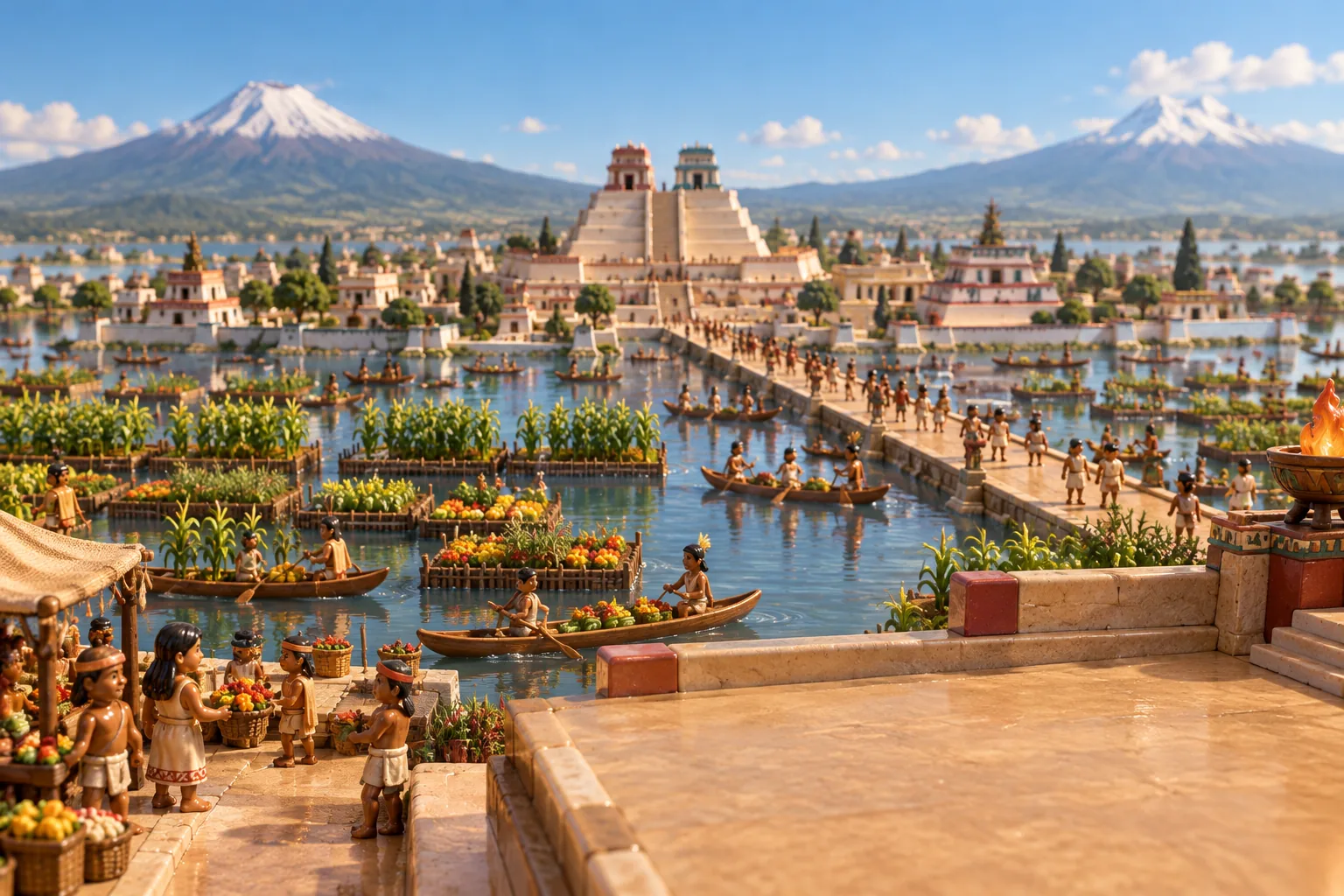
The Mexica founded Tenochtitlan on an island in Lake Texcoco, by tradition in 1325, where their god had promised them an eagle perched on a cactus. In 1428 they joined two neighbouring cities, Texcoco and Tlacopan, in the Triple Alliance and began to conquer central Mexico.
The empire did not rule its provinces directly. Conquered towns kept their own lords but sent tribute to Tenochtitlan: maize, cotton cloth, cacao, feathers, gold and captives for sacrifice. The capital grew to perhaps 200,000 people, joined to the shore by long causeways and fed by floating gardens called chinampas and an aqueduct. At its centre stood the Templo Mayor, a pyramid with twin shrines to the rain god Tlaloc and the war god Huitzilopochtli.
In 1519 Hernán Cortés landed with a few hundred Spaniards. Moctezuma II received them in the city, became their prisoner and died in 1520. The Spaniards were driven out, but smallpox swept the city, and with tens of thousands of Indigenous allies, above all from Tlaxcala, Cortés besieged Tenochtitlan. It fell on 13 August 1521, and Mexico City was built on its ruins.
Read more on Wikipedia
Sources: en.wikipedia.org/wiki/Aztec Empire, en.wikipedia.org/wiki/Tenochtitlan, en.wikipedia.org/wiki/Fall of Tenochtitlan


