
Middle Ages · person
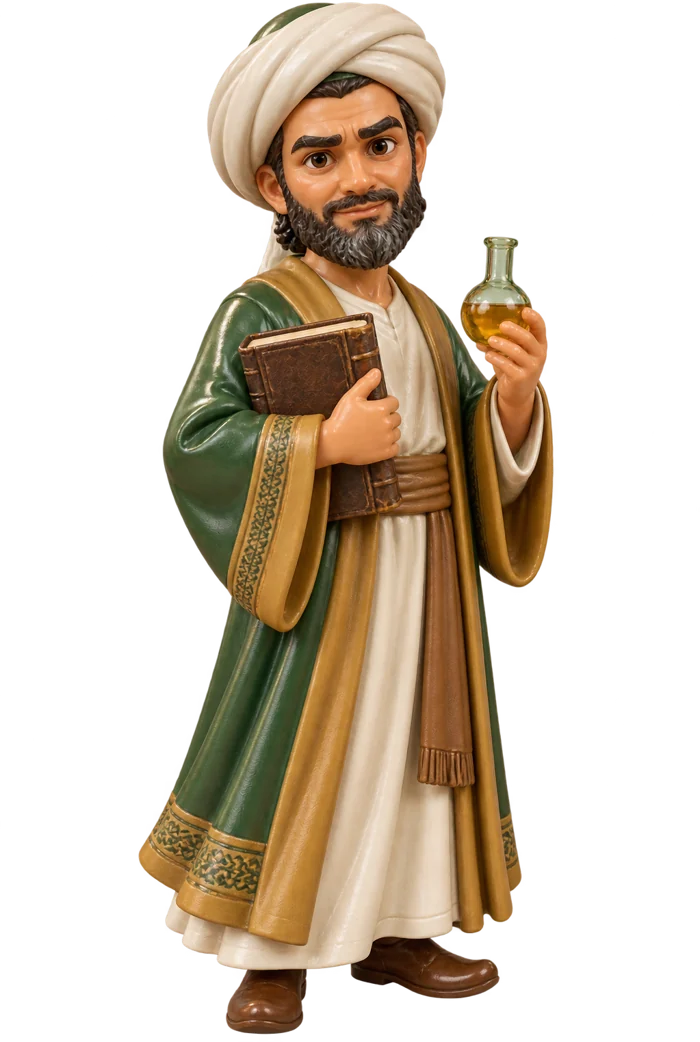
Avicenna
Between treating princes and serving as a vizier, a Persian doctor wrote a five-book encyclopedia of medicine that Europe's universities would teach for six hundred years.
Abu Ali al-Husayn ibn Sina, known in the West as Avicenna, was born around 980 in the village of Afshana near Bukhara, the capital of the Samanid realm, to a Persian family; his father was an official from Balkh. By ten he knew the whole Quran by heart, he learned arithmetic from an Indian greengrocer, and after reading Ptolemy's Almagest and Euclid's Elements with the scholar al-Natili he carried on alone. At 17 he became a physician to the Samanid emir Nuh II.
After the Samanid state fell in 999 he moved from court to court: Gurganj in Khwarazm, then Gorgan, then Ray around 1014, where he treated the Buyid amir Majd al-Dawla for melancholia. In Hamadan the amir Shams al-Dawla made him his vizier. In these years he finished The Canon of Medicine, five books on the principles of medicine, on drugs, on diseases and on their cures, and wrote The Book of Healing, a vast encyclopedia of logic, natural science, mathematics and metaphysics in the tradition of Aristotle.
From the 1020s he served Ala al-Dawla in Isfahan, the most stable years of his life, and wrote works in Persian such as the Danishnama. In 1037, while travelling with Ala al-Dawla, he fell ill with the colic that had troubled him all his life and died in Hamadan, where he was buried. Of some 450 works, about 240 survive. In Europe the Canon became a standard textbook at many universities and stayed in use as late as 1650.
Read more on Wikipedia
Sources: en.wikipedia.org/wiki/Avicenna
