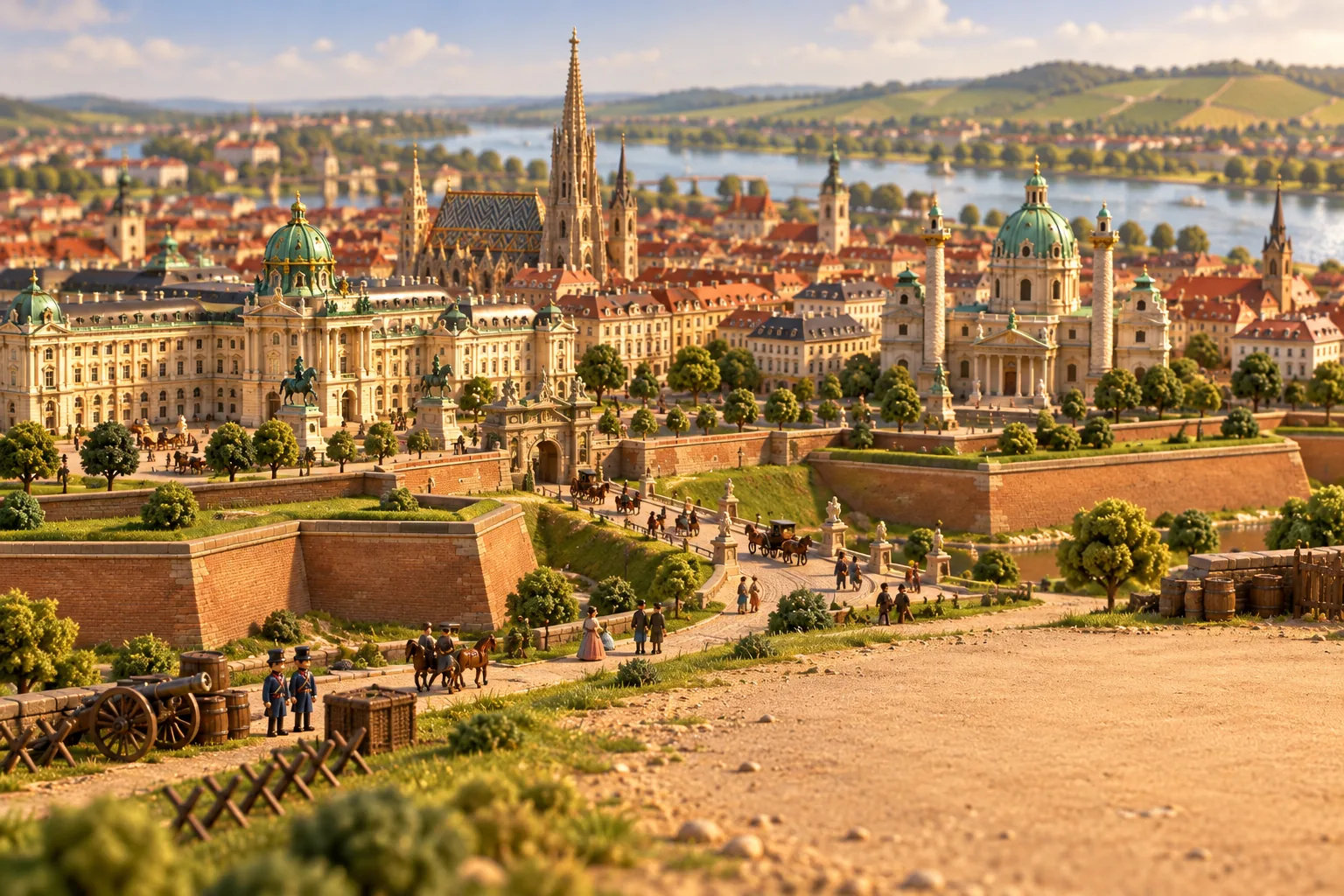

Industrial age · state
Austrian Empire
Its chancellor Metternich steered Europe's conservative order for three decades, until revolution in 1848 forced him to flee Vienna for London.
In 1804, after Napoleon took the title Emperor of the French, the Holy Roman Emperor Francis II took the new title Emperor of Austria as Francis I. His scattered Habsburg lands became, in law, a single state, though the Kingdom of Hungary kept its own king and diet. After defeats at Ulm and Austerlitz and the Treaty of Pressburg, Francis dissolved the Holy Roman Empire on 6 August 1806.
Klemens von Metternich became foreign minister in 1809. He first arranged the marriage of Francis's daughter Marie-Louise to Napoleon, then took Austria back into the war, and it played a decisive part in Napoleon's fall in 1813–14. Metternich was the chief architect of the Congress of Vienna in 1815, which made Austria the leading member of the German Confederation and gave it northern Italy. Through the Carlsbad Decrees of 1819 he censored the press and universities and ran a wide spy network. The empire fought no wars until 1848, and by 1843 it had 37.5 million people.
In March 1848 revolution reached Vienna. Metternich resigned on 13 March, serfdom was abolished, and the ailing Ferdinand I gave the throne to his 18-year-old nephew Franz Joseph. Russian and Austrian armies crushed the Hungarian revolt in 1849. Austria then lost Lombardy to Sardinia and France in 1859 and was beaten by Prussia in 1866. The Compromise of 1867 turned the empire into Austria-Hungary.
Read more on Wikipedia
Sources: en.wikipedia.org/wiki/Austrian Empire, en.wikipedia.org/wiki/Revolutions of 1848 in the Austrian Empire

