
Industrial age · state
Austria
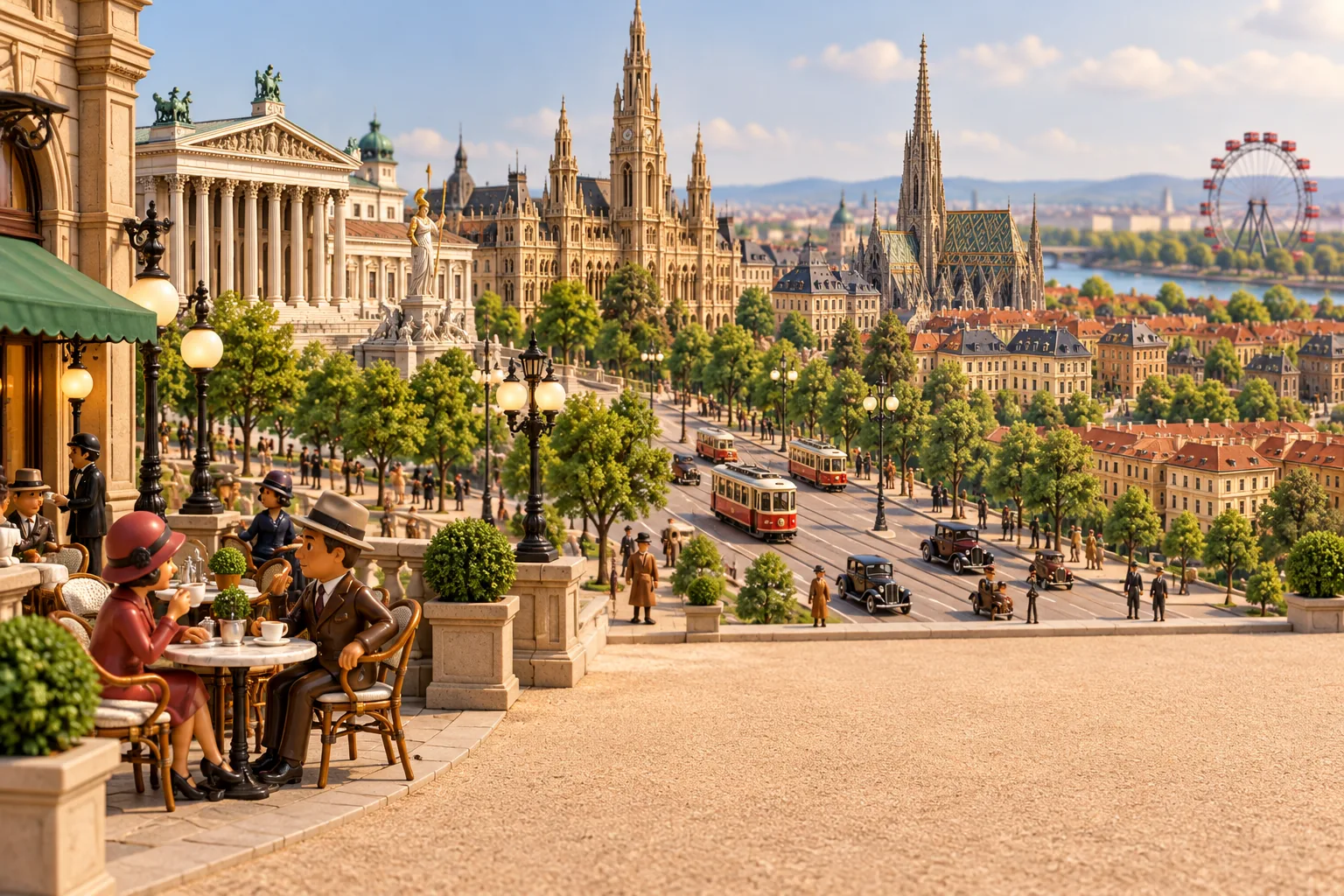
When the Habsburg empire fell apart in 1918, its German-speaking core was left as a small republic that many of its own citizens doubted could survive.
On 12 November 1918, a day after the emperor withdrew from state business, German-Austria declared itself a republic and part of Germany. The Allies refused. The Treaty of Saint-Germain of 10 September 1919 forbade union with Germany, and the state became the Republic of Austria: a landlocked country of about 6.5 million people, whose capital of almost two million had lost the empire that fed it.
Inflation wrecked the krone: by 1922 one US dollar was worth 19,000 of them. Chancellor Ignaz Seipel won a League of Nations loan, and in 1924 the schilling replaced the krone. Vienna was run by the Social Democrats, and in the years of Red Vienna the city built more than 60,000 flats around green courtyards. Both the left and the Catholic right kept armed militias. In July 1927, after right-wing gunmen were acquitted, protesters burned the Ministry of Justice and police shot dead 89 people.
In 1933 Chancellor Engelbert Dollfuss shut down parliament. After a short civil war in February 1934 the Social Democrats were banned, and in July Nazis murdered Dollfuss in a failed coup. On 12 March 1938 German troops marched in and Austria was annexed to Hitler's Reich. Restored in 1945 and occupied by the four Allies, it regained full independence with the State Treaty of 15 May 1955 and joined the European Union in 1995.
Read more on Wikipedia
Sources: en.wikipedia.org/wiki/Austria, en.wikipedia.org/wiki/First Austrian Republic, en.wikipedia.org/wiki/Red Vienna, en.wikipedia.org/wiki/Karl-Marx-Hof