Industrial age · state
Ashanti Empire
Its kings were enthroned on a Golden Stool that bound the nation together, and its armies held off Britain for most of a century.
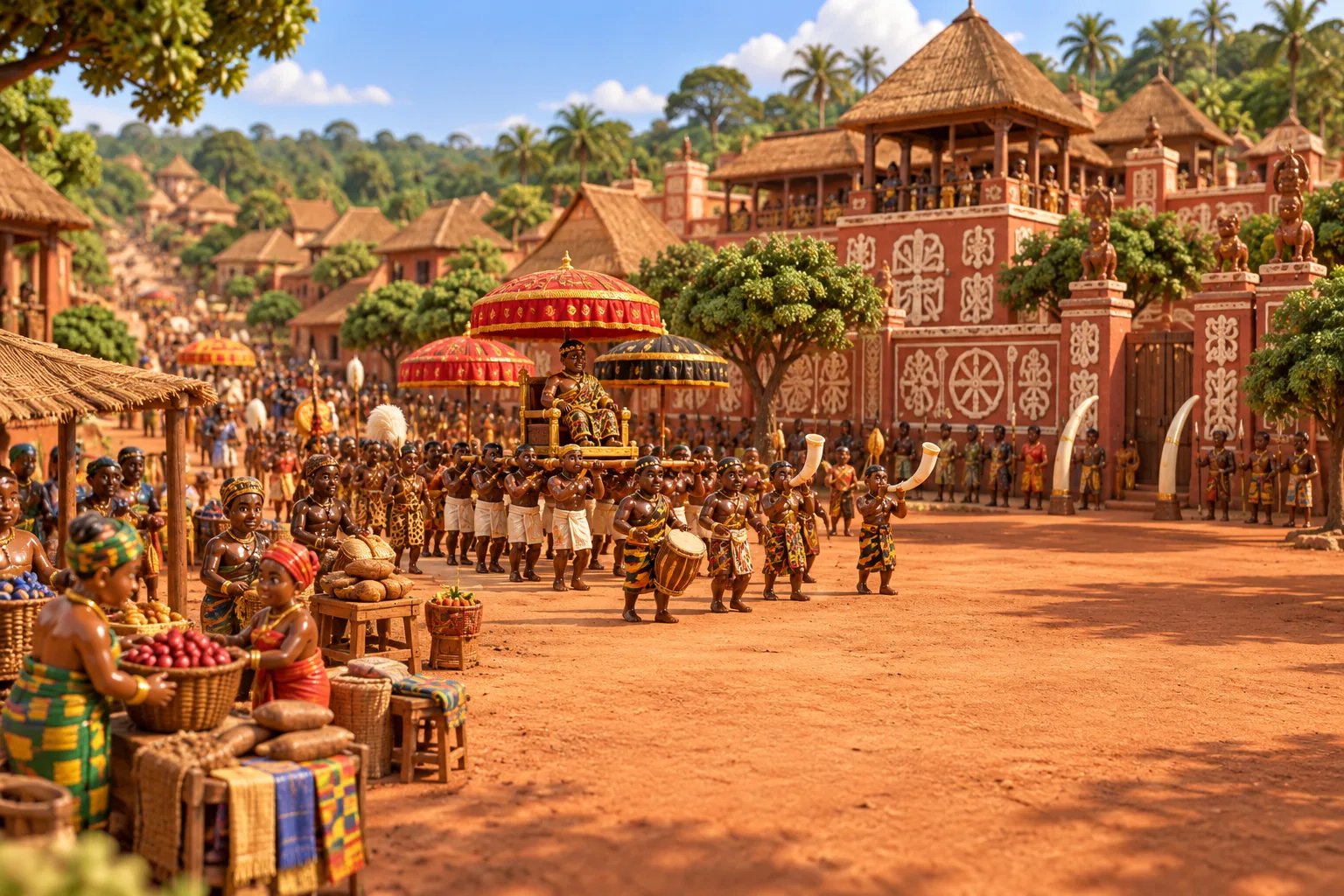
In the late seventeenth century the Akan states around Kumasi were subject to the powerful kingdom of Denkyira. Their ruler Osei Tutu and his priest and adviser Okomfo Anokye united them around the Golden Stool, the Sika Dwa, as the one symbol of their union, and in 1701 they defeated Denkyira at the Battle of Feyiase. The allied rulers recognised Kumasi as their centre and Osei Tutu as Asantehene, king of the Asante.
The kingdom grew into an empire covering most of modern Ghana and parts of Ivory Coast and Togo. Its wealth came from gold, farming and trade, including the slave trade with Europeans on the coast. Okomfo Anokye's Seventy-Seven Laws served as its constitution. Kumasi had a vast palace of courts and squares, and road wardens policed well-kept roads running north towards the Niger.
Over the nineteenth century the Asante fought five wars with Britain. In 1824 they defeated and killed the British commander Sir Charles MacCarthy and kept his skull as a gold-rimmed drinking cup. In 1874 Garnet Wolseley's army burned Kumasi, and in 1896 the British deposed King Prempeh I and exiled him to the Seychelles. Yaa Asantewaa, Queen Mother of Ejisu, led a last rising in 1900, the War of the Golden Stool, and on 1 January 1902 Asante became part of the Gold Coast colony.
Read more on Wikipedia
Sources: en.wikipedia.org/wiki/Asante Empire, en.wikipedia.org/wiki/Golden Stool, en.wikipedia.org/wiki/Anglo-Ashanti wars


