Industrial age · state
Argentine Confederation
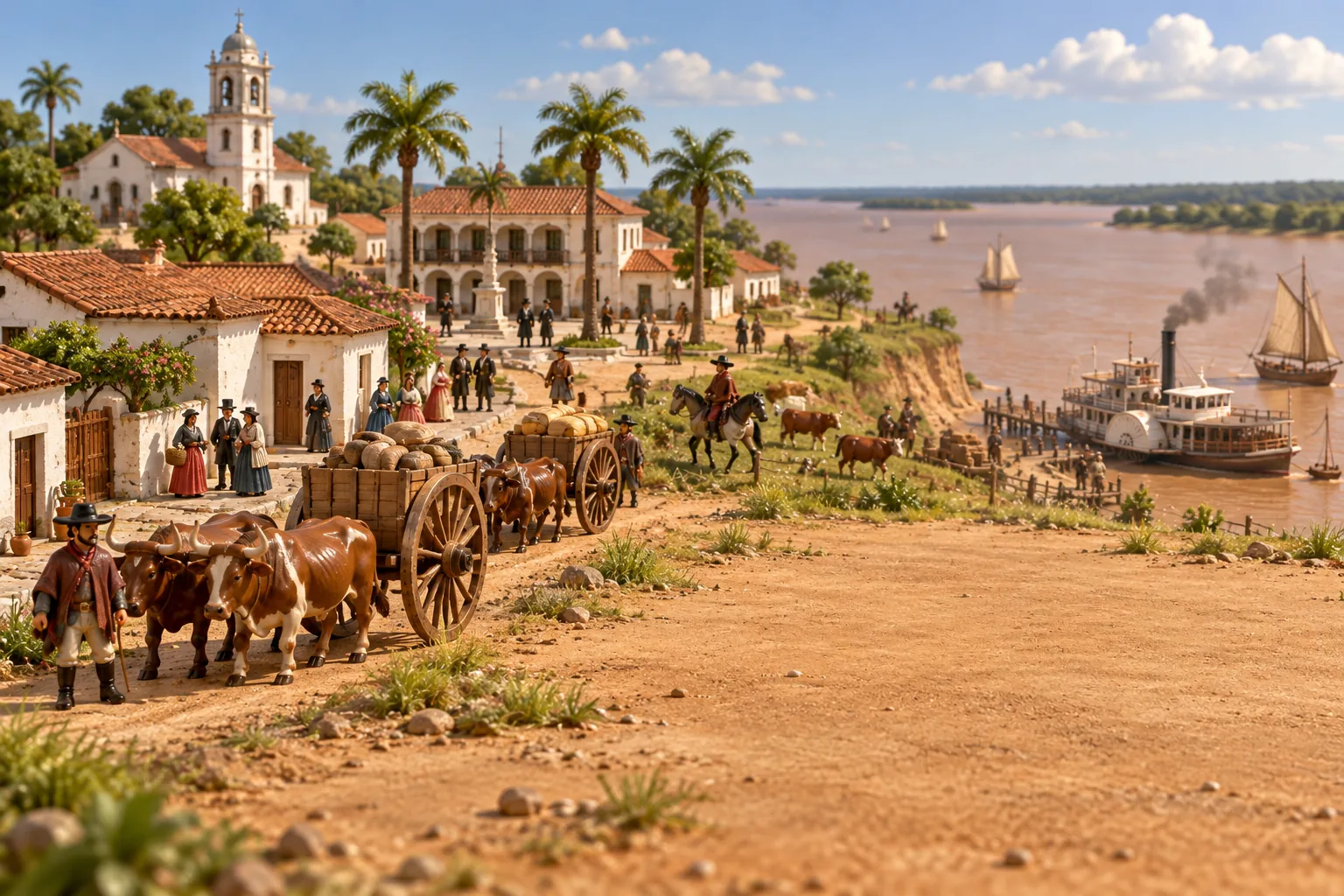
For most of the 1850s the capital of Argentina was the river town of Paraná, because the rich province of Buenos Aires had walked out of the country.
After the central government collapsed in 1820, each province of the old Río de la Plata ruled itself. From 1831 they were bound only by the Federal Pact, a confederation without a head of state, and the governor of Buenos Aires handled foreign affairs for all. For most of the time that governor was the rancher Juan Manuel de Rosas, the Restorer of the Laws. He survived a French blockade, a war with the Peru–Bolivian Confederation and long revolts, and in 1845 his men stretched chains across the Paraná at Vuelta de Obligado against an Anglo-French fleet.
Justo José de Urquiza, governor of Entre Ríos, wanted his province free to trade directly with the world. He turned against Rosas and, with Brazil and Uruguay, beat him at Caseros on 3 February 1852. Rosas fled to exile in England. On 1 May 1853 a convention in Santa Fe adopted a national constitution drawing on the ideas of Juan Bautista Alberdi.
Buenos Aires refused to join and became a separate state, so the Confederation made Paraná its capital. Urquiza beat Bartolomé Mitre at Cepeda in 1859 and Buenos Aires agreed to come back, but fighting returned. At Pavón on 17 September 1861 Urquiza withdrew and left the field to Mitre, who became the first president of a united Argentine Republic.
Read more on Wikipedia
Sources: en.wikipedia.org/wiki/Argentine Confederation, en.wikipedia.org/wiki/Juan Manuel de Rosas, en.wikipedia.org/wiki/Battle of Vuelta de Obligado, en.wikipedia.org/wiki/Battle of Caseros, en.wikipedia.org/wiki/Battle of Pavón