Antiquity · state
Anuradhapura Kingdom
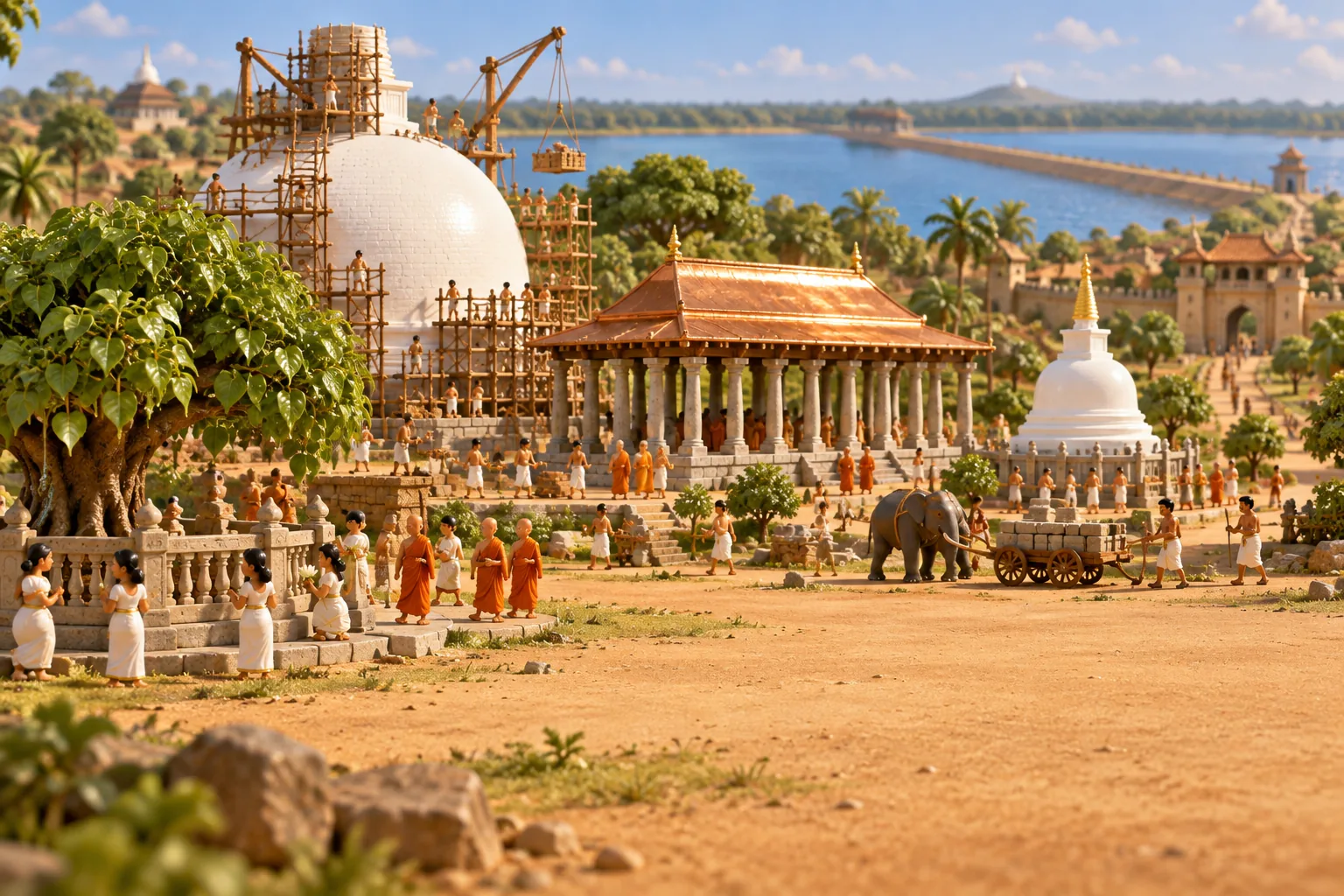
Its kings raised brick stupas that rivalled the pyramids, and a fig tree planted from the Buddha's own tree still grows in their capital.
According to the chronicle Mahāvaṃsa, the kingdom was founded by Pandukabhaya, who in 377 BC made the village of Anuradhagama his capital and laid out the city with gates and quarters. Under King Devanampiya Tissa (250–210 BC), an ally of the Mauryan emperor Ashoka, the monk Mahinda, Ashoka's son, brought Buddhism to the island. The nun Sanghamitta followed with a sapling of the tree under which the Buddha attained enlightenment, and it was planted in the Mahamevna gardens.
The kingdom was often invaded from South India. Elara, a Tamil king of Chola origin, ruled the north until Dutthagamani (161–137 BC) defeated him and united the whole island. Dutthagamani began the great stupas with the Ruwanwelisaya, 91 metres high, and built the Lovamahapaya, roofed entirely with copper. Later kings dug enormous reservoirs and canals that watered the dry plains, and in the 4th century the Buddha's tooth relic arrived from Kalinga and became the symbol of kingship.
In all, 122 kings reigned in the Anuradhapura period, almost all of them from this city. At the end of the 10th century the Cholas of South India overran the north. In 1017 they captured King Mahinda V, who had fled to Ruhuna, and took him to India, where he died in captivity. The city was sacked, and the capital later moved to Polonnaruwa.
Read more on Wikipedia
Sources: en.wikipedia.org/wiki/Anuradhapura Kingdom, en.wikipedia.org/wiki/Anuradhapura