Antiquity · state
Macedonia
A kingdom of herders on the edge of the Greek world produced a father who conquered Greece and a son who conquered Persia all the way to the Indus.
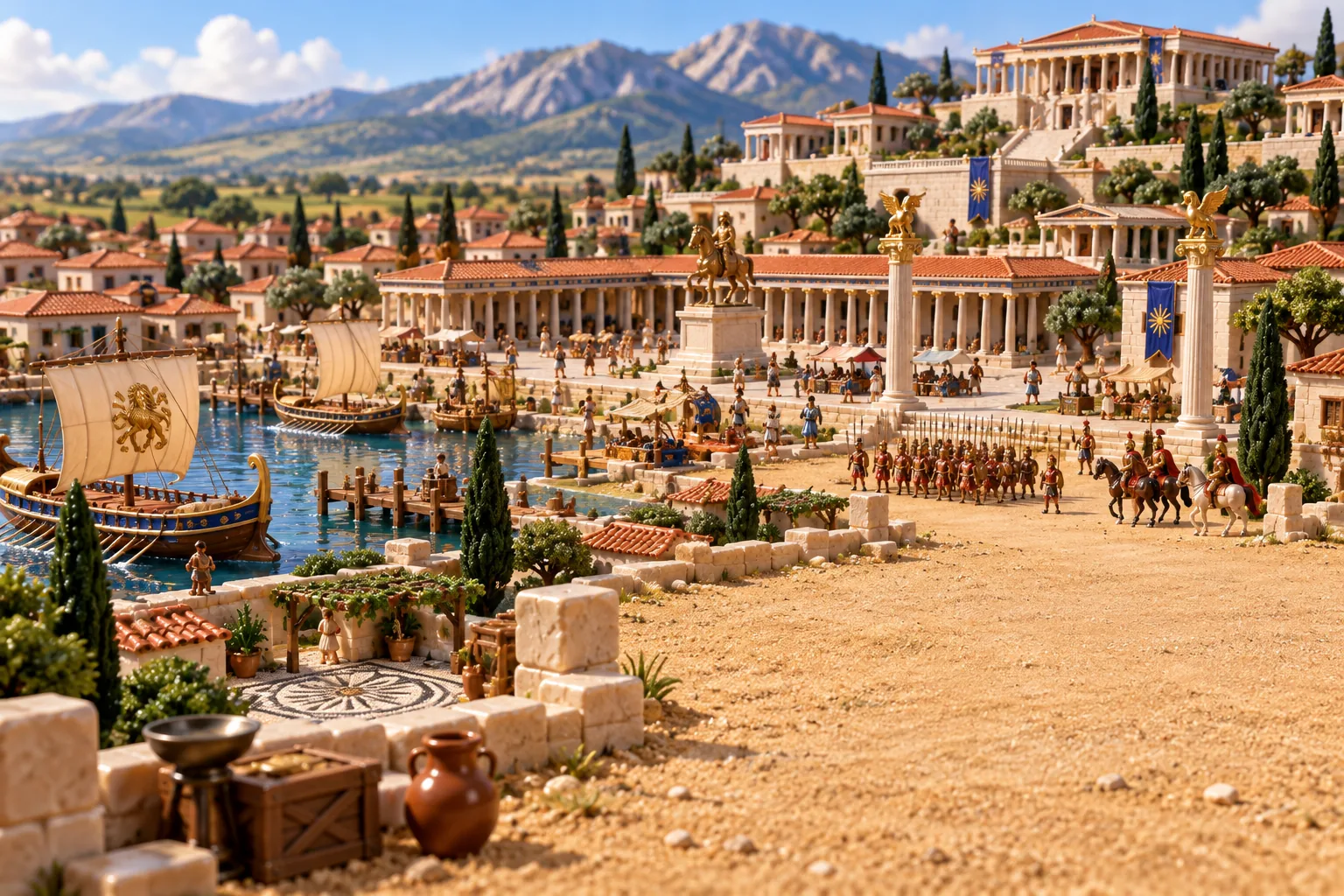
Macedonia began as a small kingdom of the Argead dynasty around Aigai, today's Vergina, where an early king probably set up his capital in the mid-seventh century BC. It lay outside the world of Athens, Sparta and Thebes and was for a time a vassal of Persia. Archelaus I moved the capital north to Pella and invited the Athenian playwright Euripides to his court.
Philip II, who reigned from 359 to 336 BC, rebuilt the army around phalanxes armed with the long sarissa pike and beat Athens and Thebes at Chaeronea in 338 BC. He was assassinated by his bodyguard Pausanias at the theatre of Aigai in 336 BC. His son Alexander the Great, once tutored by Aristotle, defeated the Persians at the Granicus in 334, Issus in 333 and Gaugamela in 331, overthrew the Achaemenid Empire and marched as far as the Indus.
Alexander died at Babylon in 323 BC, and his generals, the Diadochi, fought over his empire. Macedonia itself passed to the Antipatrid and then the Antigonid kings. It clashed with Rome: Philip V lost at Cynoscephalae in June 197 BC, and after the Third Macedonian War ended in 168 BC under King Perseus the monarchy was abolished.
Read more on Wikipedia