Early modern · war
American Revolutionary War
The army that won American independence was never larger than 17,000 men under George Washington, and it needed a French fleet to finish the job.
After Britain won the Seven Years' War in 1763, quarrels over taxes and troops grew between London and its Thirteen Colonies. On 19 April 1775 British troops marched out of Boston to secure the colonial arsenal at Concord; militiamen met them at Lexington and Concord, and the war began. In June the Second Continental Congress created the Continental Army and made George Washington its commander. On 4 July 1776 Congress adopted the Declaration of Independence.
Washington drove the British out of Boston in March 1776, but William Howe took New York City that November. Washington answered by secretly crossing the Delaware River and surprising the Hessian garrison at Trenton on 26 December, then winning again at Princeton. In October 1777 a British army under John Burgoyne surrendered at Saratoga. The victory convinced France that the Americans could win, and the two signed an alliance in February 1778; Spain joined the war against Britain in 1779. During the hard winter at Valley Forge, poor conditions and short supplies killed some 2,000 of Washington's soldiers.
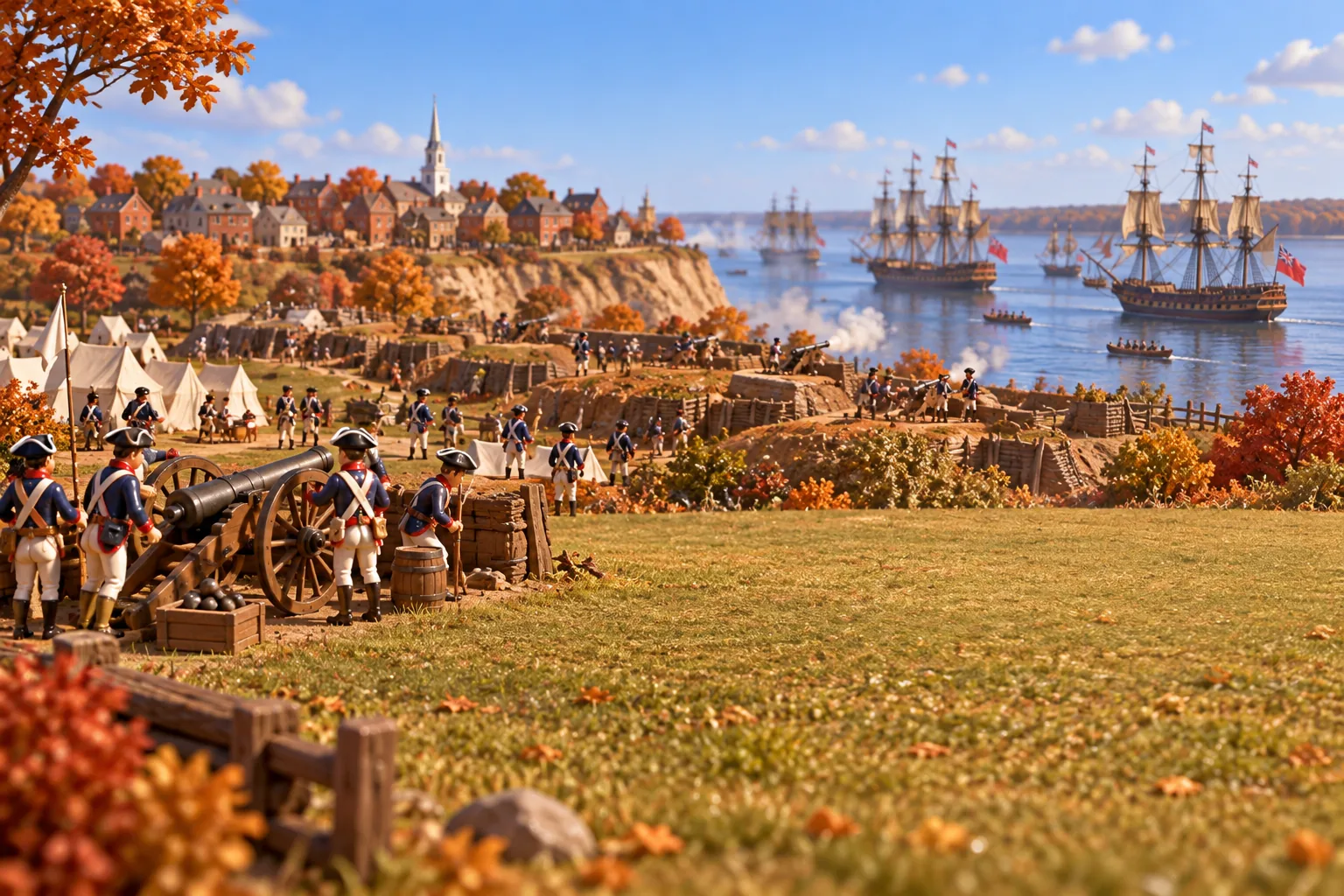
The British then turned south and took Charleston in 1780. But in 1781 Charles Cornwallis dug in at Yorktown, Virginia. A French fleet under Admiral de Grasse beat back the Royal Navy off the Chesapeake on 5 September, cutting off his escape by sea, and about 19,000 French and American troops besieged the town. Cornwallis surrendered in October 1781. In the Treaty of Paris, signed on 3 September 1783, Britain recognised the independence of the United States.
Read more on Wikipedia


