Antiquity · war
Alexander in India
Alexander believed the edge of the world lay only about 1,000 km ahead, but his own soldiers refused to take him there.
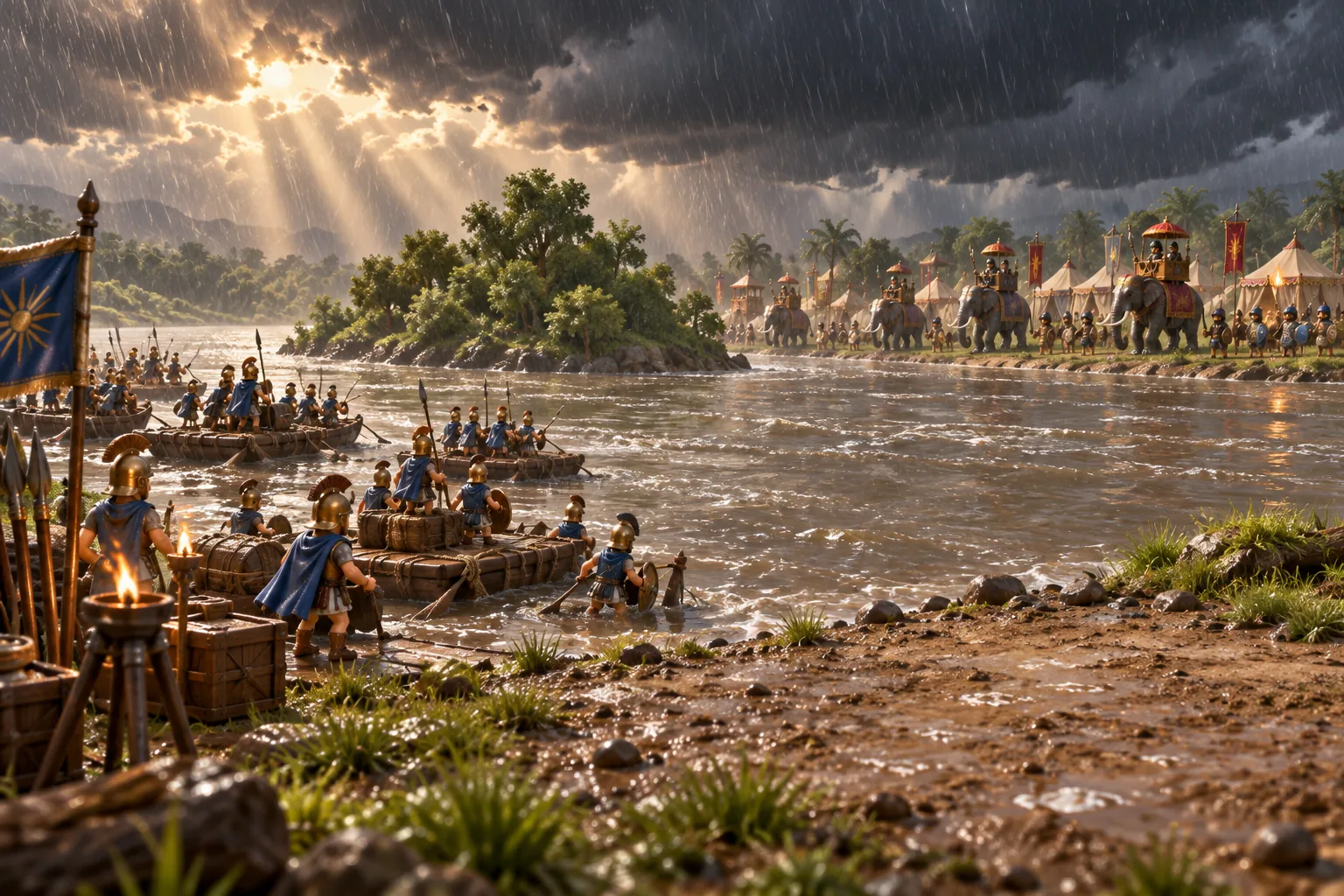
Having conquered the Persian Empire, Alexander the Great led his Macedonian army into the northwest of the Indian subcontinent in 327 BC. King Omphis of Taxila submitted at once. Others resisted: at the fortress of Massaga Alexander was badly wounded in the ankle before it fell. In July 326 BC he reached the Hydaspes, today's Jhelum, where King Porus waited on the far bank with war elephants.
Alexander could not cross head-on, so he slipped part of his army across the river elsewhere. In the battle that followed, his horse archers and cavalry broke Porus' cavalry, while the phalanx faced the elephants. Plutarch says the fighting lasted until the eighth hour of the day, and it may have been the Macedonians' costliest battle. Porus, wounded but still standing, was asked how he wished to be treated. 'Treat me, Alexander, the way a King treats another King,' he is said to have answered, and soon afterwards Porus was marching with Alexander, bringing elephants and 5,000 of his own troops.
Further east lay the powerful Nanda Empire. At the Hyphasis, the modern Beas, the army mutinied: the men were exhausted after years of marching and, as their general Coenus told Alexander, longed to see their parents, wives and children again. Alexander turned back. He went down the Indus, fighting more tribes on the way, and then led part of his army west across the Gedrosian desert to Persia.
Read more on Wikipedia
Sources: en.wikipedia.org/wiki/Indian campaign of Alexander the Great
