Industrial age · person
Alan Turing
To answer a puzzle about the limits of logic, a 23-year-old Cambridge fellow imagined a machine reading symbols off a tape and described every computer to come.
Alan Mathison Turing was born in Maida Vale, London, on 23 June 1912, while his father was on leave from the Indian Civil Service. At 13 he went to Sherborne School in Dorset, where teachers who prized the classics had little time for his love of science. There his close friend Christopher Morcom shared his passion, and Morcom's early death in 1930 marked him deeply. Turing studied mathematics at King's College, Cambridge, won first-class honours and was elected a Fellow of the college.
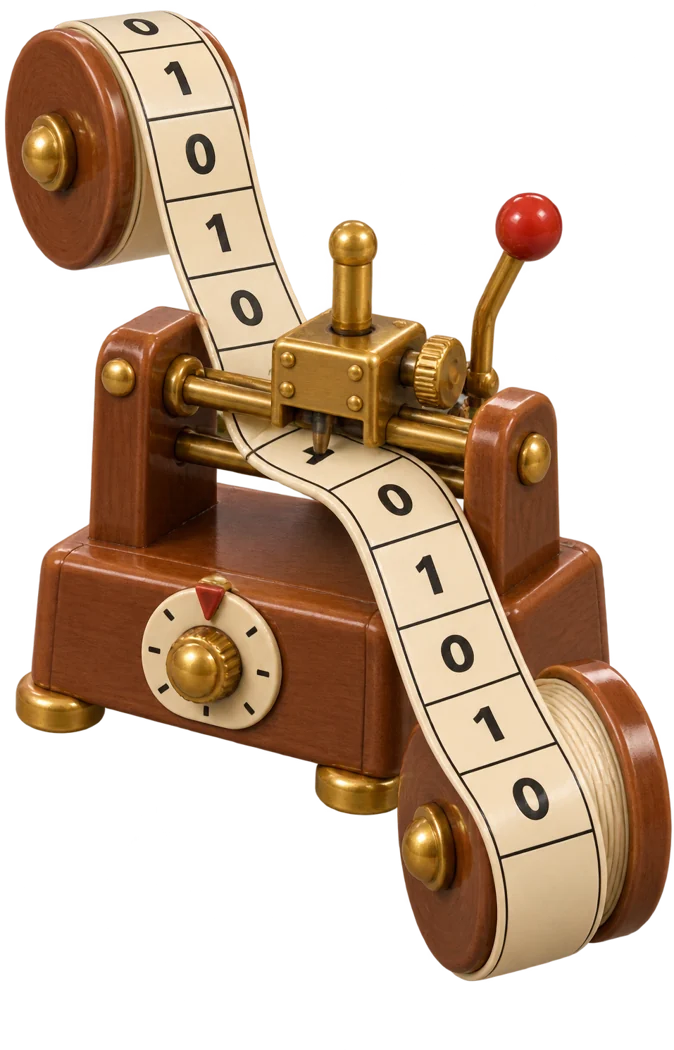
In 1928 the German mathematician David Hilbert had asked whether a mechanical procedure could decide the truth of any mathematical statement. On 28 May 1936 Turing delivered his 36-page answer, "On Computable Numbers, with an Application to the Entscheidungsproblem". He imagined a simple machine that reads and writes symbols on a tape, and showed that no such machine can settle every question. The idea, now called the Turing machine, became the model for the general-purpose computer. After a doctorate at Princeton in 1938 he joined Bletchley Park in the Second World War and led Hut 8, which attacked German naval Enigma messages.
After the war he designed the Automatic Computing Engine, worked on the early Manchester computers and in 1950 proposed what became the Turing test. In 1952 he was prosecuted for a relationship with a man and accepted chemical castration. He died of cyanide poisoning on 7 June 1954, aged 41; the inquest recorded suicide. He received a royal pardon in 2013.
Read more on Wikipedia
Sources: en.wikipedia.org/wiki/Alan Turing


