
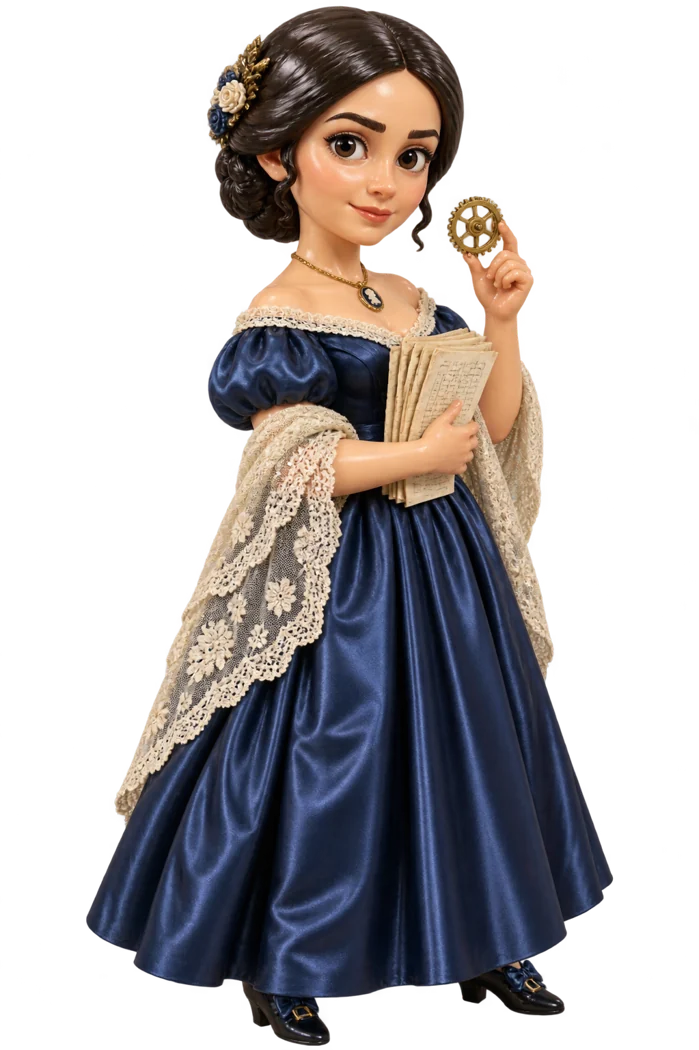
Industrial age · person
Ada Lovelace
A century before electronic computers, she saw that a machine of brass gears could handle not only numbers but music and any other symbols.
Augusta Ada Byron was born in London on 10 December 1815, the only legitimate child of the poet Lord Byron and the reformer Anne Isabella Milbanke. Five weeks later her mother left Byron, taking the baby with her, and he left England for good a few months after. Her mother had her taught mathematics and science, partly to root out any of the "insanity" she accused Byron of. At twelve, in 1828, Ada set out to build wings and planned a book, Flyology, after studying the anatomy of birds. Her tutors included William Frend, Augustus De Morgan and the scientist Mary Somerville.
On 5 June 1833, aged 17, she went with her mother and Somerville to one of Charles Babbage's Saturday evening parties, and a long friendship began. In 1835 she married William King, later the 1st Earl of Lovelace. Babbage designed a general-purpose mechanical computer, the Analytical Engine, which was never built. When the Italian engineer Luigi Menabrea wrote a paper on it in French, Lovelace translated it and added seven notes, A to G, about three times longer than the article. They appeared in September 1843 under her initials, AAL. Note G set out how the machine could calculate Bernoulli numbers, often called the first published computer program.
She called her approach "poetical science". In the later 1840s she apparently lost more than £3,000 betting on horses. Lovelace died of cancer in Marylebone on 27 November 1852, aged 36, and at her own request was buried beside her father in Hucknall.
Read more on Wikipedia
Sources: en.wikipedia.org/wiki/Ada Lovelace


