Antiquity · state
Persian Empire
In twenty years one Persian king went from ruling a small vassal kingdom to holding the largest empire the world had yet seen.
In 550 BC Cyrus, king of the small kingdom of Anshan in south-western Iran, overthrew his overlord, the king of the Medes. He went on to take Lydia in Anatolia and, in 539 BC, Babylon, where he let the exiled Jews go home and rebuild their temple in Jerusalem. His son Cambyses added Egypt in 525 BC.
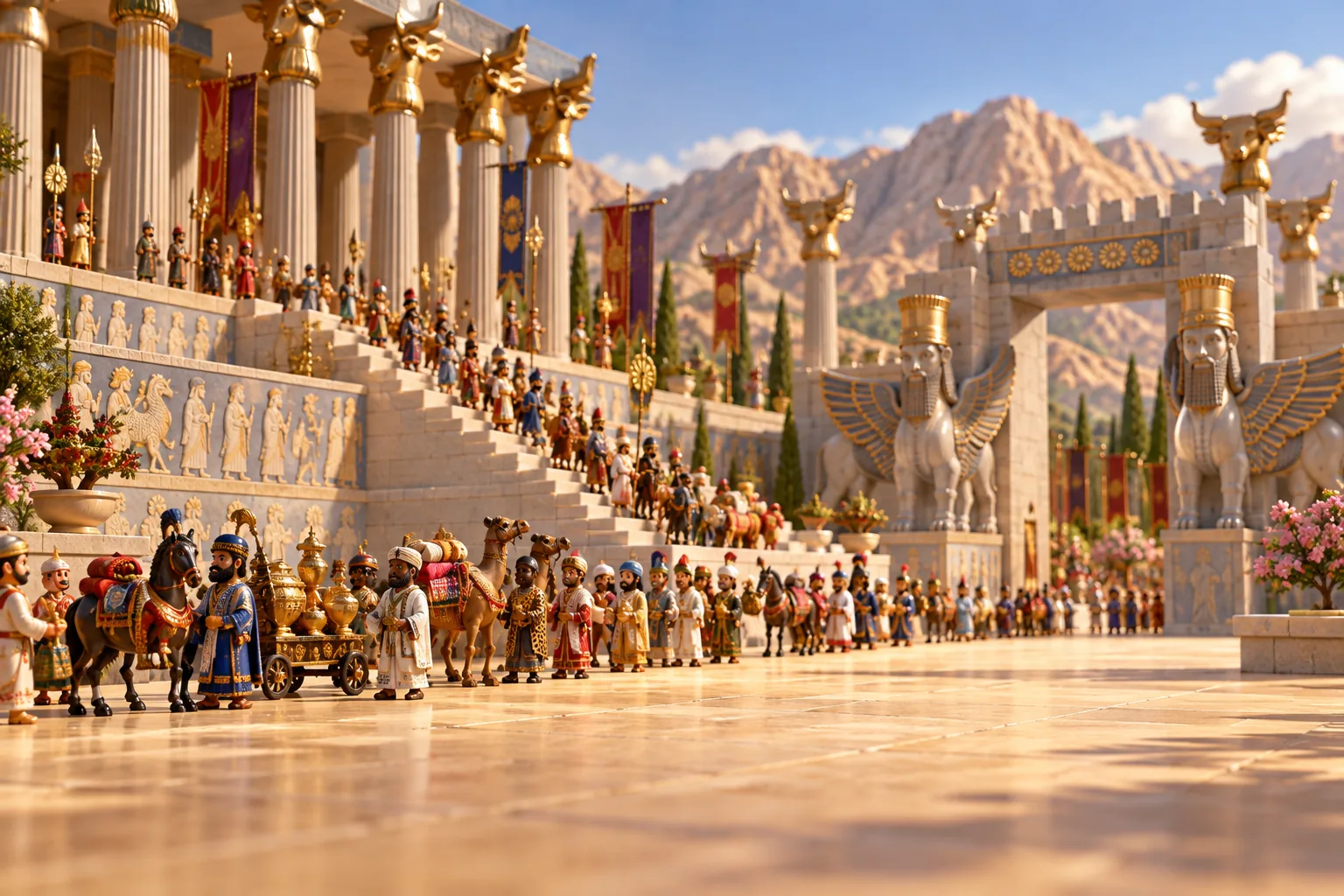
Darius I, who took the throne in 522 BC, made the conquests into a state. He divided it into provinces ruled by governors called satraps, set standard weights and a gold coin, the daric, and linked the provinces with roads and royal couriers; the Royal Road ran some 2,500 kilometres from Sardis to Susa. He began the palace city of Persepolis, whose stone reliefs show delegations from the whole empire bringing gifts. At its height the empire stretched from Egypt and the Balkans to the Indus.
The Greeks fought it off at Marathon in 490 BC and, against Xerxes, at Salamis in 480 BC. A century and a half later Alexander of Macedon invaded, beat Darius III at the Granicus, Issus and Gaugamela, and in 330 BC burned Persepolis. Darius was murdered by one of his own satraps the same year.
Read more on Wikipedia
Sources: en.wikipedia.org/wiki/Achaemenid Empire, en.wikipedia.org/wiki/Royal Road, en.wikipedia.org/wiki/Cyrus Cylinder


