
Middle Ages · state
Abbasid Caliphate
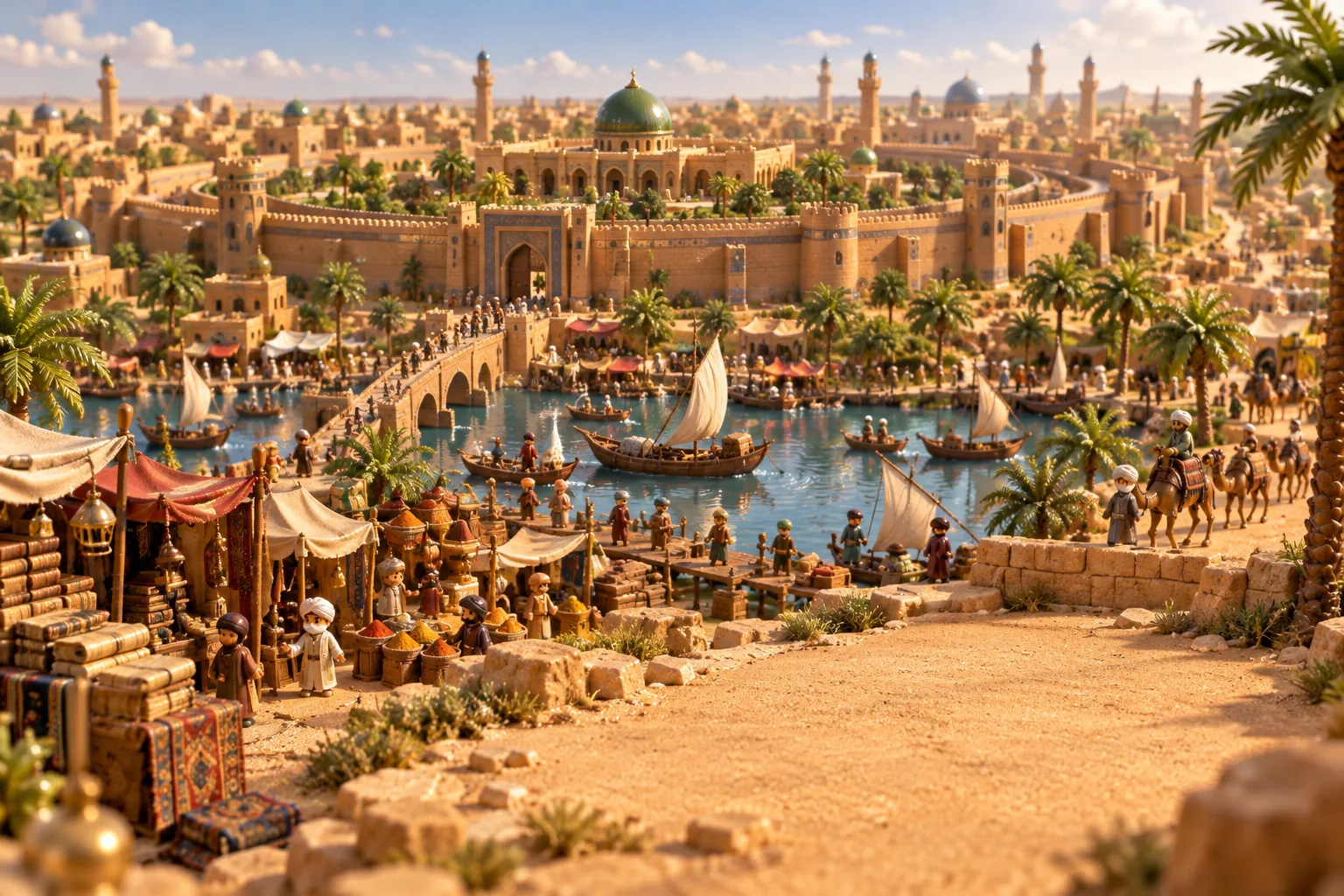
From a round city on the Tigris, the Abbasid caliphs presided over an age of books, numbers and stories that still shapes the words we use.
The Abbasids descended from Abbas, an uncle of the Prophet Muhammad. Their revolution began in Khurasan, far to the east of the Umayyad heartland in Syria, and early in 750 their army defeated the last Umayyad caliph, Marwan, near the Great Zab river. In 762 the caliph al-Mansur founded Baghdad on the Tigris, near ancient Ctesiphon, and named it Madinat al-Salam, the City of Peace.
The caliphate's height is linked with Harun al-Rashid, who reigned from 786 to 809. Baghdad was laid out as a round city with rings of brick walls and four great gates, and it became the centre of the Islamic Golden Age, with scholars working in the House of Wisdom. Al-Khwarizmi wrote the book on al-jabr that gave algebra its name, and many tales of the Thousand and One Nights were gathered in this era.
After Harun's death his sons al-Amin and al-Ma'mun fought a civil war. Provinces drifted away under local dynasties, and the caliphs came to rely on Turkic slave soldiers. From 945 the Buyids and from 1055 the Seljuk Turks held real power in Baghdad. The caliphs won back Iraq in the twelfth century, but in 1258 the Mongols under Hulagu Khan sacked Baghdad and executed the caliph al-Musta'sim.
Read more on Wikipedia


